


Ask a chatbot for your birth chart and you get an answer in seconds. It names your rising sign, your Moon sign, maybe a nakshatra (birth star). It sounds sure of itself. But often nothing was calculated at all. The chatbot wrote what a birth chart usually looks like.
That is the main problem with many AI astrologer apps and with ChatGPT astrology chats. The fix is to let the AI call a real chart calculation. Then the AI only explains the result. Below, we show why chatbots guess. Then a worked example shows how one forgotten hour changes the chart. Last come six checks to run before you trust an AI reading.
Why chatbots get birth charts wrong
A language model is built to predict the next words in a sentence. It is very good at that. It does not calculate planet positions. To place the planets for a birth, you need astronomy data and careful math. You need to know where each planet was at that exact minute, seen from that exact place.
When a chatbot has no tool for this, it writes something that sounds likely instead. It may get the Sun sign right, because the Sun stays in one sign for about a month. The Moon is harder, because it moves into a new sign a little more than every two days.
The rising sign, called the lagna in Vedic astrology, is the hardest of all. It moves through all twelve signs in about a day. So it depends on the exact minute and the exact place. Without a real calculation, the rising sign is a guess with twelve possible answers.
One forgotten hour changes the whole chart
Here is a worked example. John Doe was born on August 15, 1990, at 10:30 AM in New York. New York was on daylight saving time that day, so its clocks were 4 hours behind UTC (EDT), not 5.
We ran his birth details through our chart calculation twice. The first time we gave the time zone name America/New_York, which looks up daylight saving time for that exact date. The second time we gave a fixed offset of UTC-5. That is the mistake you get when someone forgets daylight saving time.
Chart point | Correct (UTC-4, daylight time) | Wrong (UTC-5) |
|---|---|---|
Rising sign (lagna) | Virgo 19°56', Hast nakshatra | Libra 1°48', Chitra nakshatra |
Moon | Taurus 24°35', Mrigashira, 9th house | Taurus 25°10', Mrigashira, 8th house |
Sun | Cancer 28°47', 11th house | Cancer 28°49', 10th house |
Jupiter | Cancer, exalted, 11th house | Cancer, exalted, 10th house |
Look at what moved. The planets barely changed. The Moon moved about half a degree, and every planet stayed in the same sign. But the rising sign jumped about 12 degrees and crossed from Virgo into Libra. Vedic charts use whole-sign houses, where the rising sign is the 1st house. So every planet slid into a different house. A reading built on the wrong chart would talk about the wrong house for everything.
Daylight saving time has odd history, too. A birth in New York on January 15, 1974, uses UTC-4, not UTC-5. That is because the United States started daylight saving time early that year, on January 6, 1974. A chatbot that "knows" New York is UTC-5 in January would get that chart wrong.
Vedic or Western? The ayanamsa matters
There is a second trap. Western astrology mostly uses the tropical zodiac (tied to the seasons). Vedic astrology uses the sidereal zodiac (tied to the stars), which is shifted by an amount called the ayanamsa. Our calculation uses the Lahiri ayanamsa. At John Doe's birth it was about 23.73 degrees.
That gap often moves a placement back by one sign. For John Doe:
Sun: Leo in a Western chart, Cancer in a Vedic chart.
Moon: Gemini in a Western chart, Taurus in a Vedic chart.
Rising sign: Libra in a Western chart, Virgo in a Vedic chart.
Chatbots learned from both traditions at once. They often mix them in one answer, such as a Western Sun sign next to a Vedic nakshatra. Neither tradition is wrong, but a chart has to pick one and say so. Our guide to Vedic and Western charts explains the difference in more detail.
The fix: let the AI call a real calculation
The answer is not a smarter chatbot. It is to split the work. Most AI platforms let a model call functions, often called tools. You give the model a tool that sends birth details to a real chart calculation. The model's job then shrinks to two things: collecting the right inputs, and explaining the results in plain words.
The user gives a birth date, time and place.
The AI asks for anything missing, especially the birth time. It does not guess.
Your server turns the place into latitude, longitude and a time zone name, such as America/New_York.
The tool runs the calculation and gets back signs, degrees, houses and nakshatras.
The AI explains those results, and only those results.
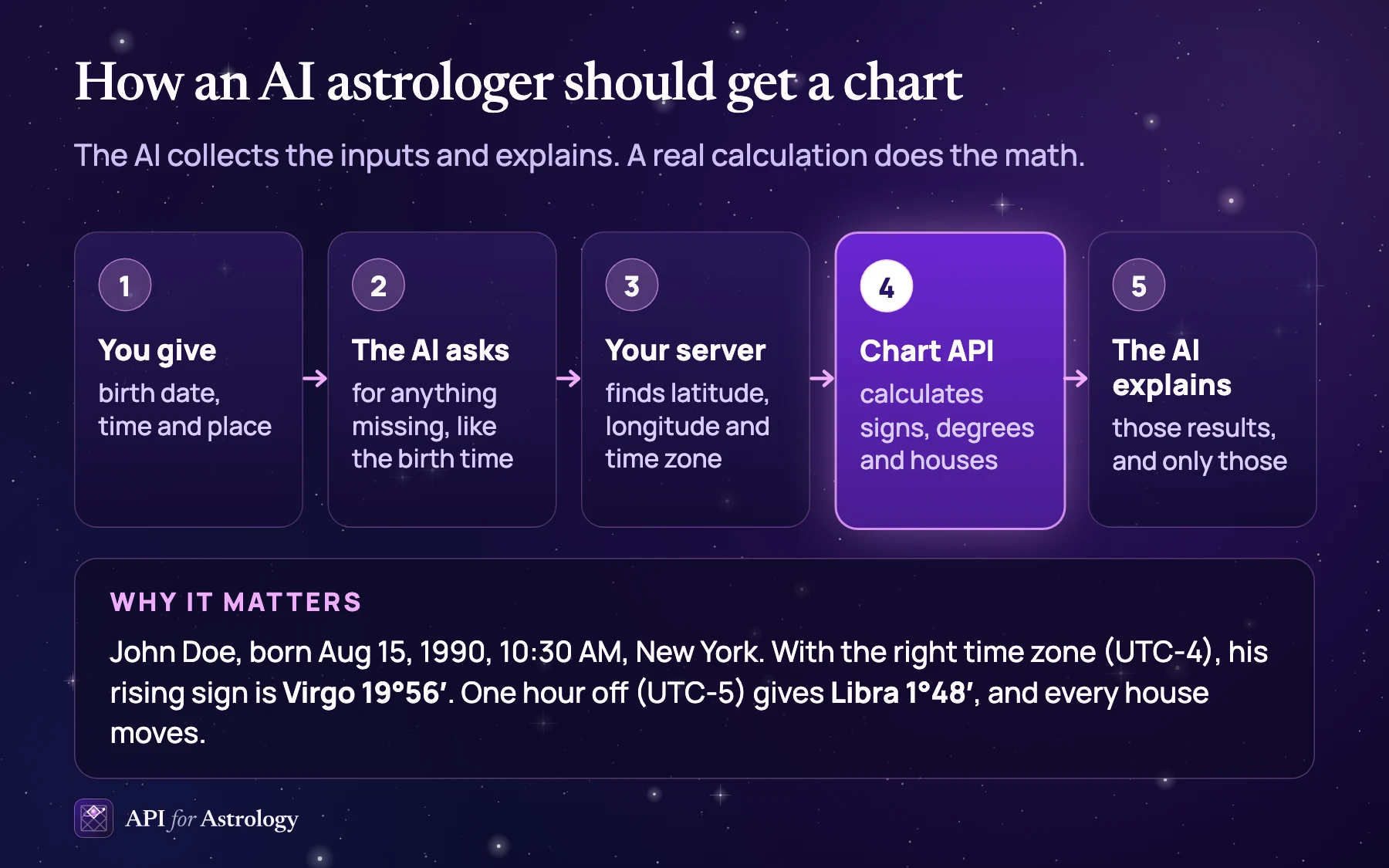
For John Doe, the AI should get facts like these instead of making them up. The rising sign is Virgo at 19°56' in Hast nakshatra. The Moon is in Taurus at 24°35' in Mrigashira nakshatra, pada 1 (the first quarter), in the 9th house. The ayanamsa is Lahiri. The time zone offset is UTC-4, with daylight saving time on. The result states the offset it used. So your app can show it, and a user can catch a mistake.
Our guide for AI assistants shows a sample tool definition. It also shows which fields to tell the model to quote word for word. The AI assistants use case shows how the pieces fit together in a product.
What a good AI astrology answer looks like
When the chart is real, the answer reads differently. A good one does these things:
States the inputs back: "Born August 15, 1990, 10:30 AM, New York (UTC-4, daylight time)."
Names its system: Vedic, sidereal zodiac, Lahiri ayanamsa, whole-sign houses.
Gives the facts first: rising sign, Moon sign and nakshatra, with degrees.
Explains as tradition: "In Vedic astrology, a Virgo lagna is read as..." instead of "You will...".
Admits limits: if the birth time is unknown, it says the rising sign and houses cannot be known. It offers only what the date can support.
A good answer is also steady. Ask the same question twice and the chart should not change. Our chart results and readings come from fixed rules, not from a language model. So the same birth details always give the same result. The AI may change its wording, but the facts under it should stay the same.
How to check an AI astrologer before you trust it
You do not need to be an astrologer to test one. Try these checks:
Does it ask for your birth time and place? If it gives a rising sign from a date alone, it guessed.
Does it say which zodiac and ayanamsa it uses? If it cannot tell you, it may be mixing systems.
Can it show the chart? A real calculation can list each planet's sign, degree and house.
Does it handle daylight saving time? Give it a summer birth and see whether it reports the right UTC offset.
Is it consistent? Ask the same thing in a new chat. The positions should match exactly.
Does it agree with a chart calculator? Enter the same details in a free kundli (Vedic birth chart) calculator and compare the rising sign and Moon sign.
Keep some perspective, too. A correct chart is not a correct prediction. Astrology is a tradition of reading a chart. Putting an AI on top does not turn it into a science. Be careful with any app that says its AI predictions are accurate, or that uses fear to sell remedies. No astrology app should take the place of a doctor, a lawyer or a financial advisor.
Try it yourself
Curious about your own chart? Enter your birth date, time and place in our free kundli tool. Then compare the result with what a chatbot told you. If you build apps, the AI assistants guide shows how to give your assistant a real chart calculation as a tool.


