Kundali matching is the step many Indian families take before a wedding. An astrologer sets the two birth charts side by side and gives the pair a score out of 36. That score is called guna milan. The method behind it is called ashtakoot, which means "eight factors."
Most families look for at least 18 of the 36 points. But the total alone is not the verdict. Two of the eight factors, nadi and bhakoot, carry 15 points between them. Some important checks also sit outside the score. Below are all eight factors with their points. Then comes a worked example for a couple born in Chicago and New York.
What kundali matching compares
The 36 points do not read the whole chart. In Vedic astrology, guna milan looks at only two things for each person. The first is the sign the Moon was in at birth. The second is the Moon's nakshatra, one of the 27 star groups the zodiac is divided into. Everything else in the two charts plays no part in the score.
This matters in two ways. First, two people with very different charts can still get the same score if their Moons sit in the same places. Second, the score is a narrow tool. It was never meant to be the only thing an astrologer looks at.
The eight kootas and their points
Each of the eight factors is called a koota. They carry from 1 to 8 points, and the points add up to 36. Some read the Moon sign, and some read the nakshatra. You can read more about each one on our ashtakoot glossary page.
Koota | Points | What it compares |
|---|---|---|
Varna | 1 | A ranking of each Moon sign by its element |
Vashya | 2 | How easily one Moon sign is led by the other, using five sign groups |
Tara | 3 | The count between the two nakshatras, taken in both directions |
Yoni | 4 | The animal symbol of each nakshatra, and how the two animals get along |
Graha maitri | 5 | Friendship between the planets that rule the two Moon signs |
Gana | 6 | Temperament: each nakshatra is Deva, Manushya or Rakshasa |
Bhakoot | 7 | How many signs apart the two Moons are |
Nadi | 8 | Which of three groups (Adi, Madhya, Antya) each nakshatra falls in |
Three of these follow simple rules. Bhakoot gives all 7 points or none. Moons 2 and 12, 5 and 9, or 6 and 8 signs apart score zero. Nadi also gives all or nothing. The same nadi on both sides scores zero, and different nadis score the full 8. For yoni, the same animal scores highest. Sworn enemies, such as the cat and the rat, score nothing. Most other pairs score 2.
The scheme is also one-sided in places. Varna, vashya and gana are read differently depending on who is the bride and who is the groom. So swapping the two people can change the score. That is why a matching request names a bride and a groom instead of person one and person two.
Why 18 points is the usual line
Eighteen out of 36 is the figure most families are told to look for. It is a custom, not a law. Other calculators draw the bands a little differently. That is one reason to show the rule behind a score, as why rule IDs matter explains. Our API labels the totals like this:
32 or more: excellent, well above what is usually asked for
26 to 31.5: very good, comfortably above the usual line
18 to 25.5: acceptable, at or above the usual minimum
Under 18: below the usual line
Notice that two couples can both score 22 and be nothing alike. One may have lost two of the heaviest factors. The other may have lost a few light ones. That is why astrologers read the eight entries, not just the total.
Nadi and bhakoot: the two checks that matter most
Nadi and bhakoot are worth 15 of the 36 points together, and both are all or nothing. A single miss on either one can drop a couple below 18. When nadi or bhakoot scores zero, it is called a dosha, a fault in the match.
But every classical text that names these doshas also names ways they are cancelled. Our API applies these standard reliefs and shows the score both before and after them:
Nadi dosha is lifted when both Moons are in the same sign. It is also lifted when the two nakshatras share the same ruling planet. A third relief is when both people have the same nakshatra in different signs.
Bhakoot dosha is lifted when the rulers of the two Moon signs are friends. It is also lifted when both Moon signs have the same ruler.
Whether to accept a relief is still up to the astrologer. That is why the raw total is always kept next to the relieved one.
Checks that sit outside the 36 points
Some important checks carry no points at all. They are reported beside the score and never added to it:
Manglik comparison. This looks at Mars in each full chart, so it needs birth times, not just the Moons. Two manglik charts are said to cancel each other out. One manglik chart and one without is the case the tradition warns about.
Rajju and vedha. Pass-or-fail checks on the two nakshatras, read mainly in South India.
Dashakoot. The southern method: ten checks, each answered yes or no, with five treated as required.
Papa samyam. A count of difficult planets (the Sun, Mars, Saturn, Rahu and Ketu) in sensitive houses, compared between the two charts.
A worked example: Jane Doe and John Doe
Here is a worked example with sample birth details. Jane Doe (bride) was born on March 22, 1992, at 2:45 PM in Chicago. John Doe (groom) was born on August 15, 1990, at 10:30 AM in New York. We sent both birth details to our matching API.
Jane's Moon is in Scorpio, in the nakshatra Vishakha. John's Moon is in Taurus, in Mrigashira. Here is how the eight kootas scored:
Koota | Points | Why |
|---|---|---|
Varna | 0 of 1 | Jane is Brahmin (water sign), John is Vaishya (earth sign) |
Vashya | 1 of 2 | Scorpio is in the insect group, Taurus in the four-legged group |
Tara | 1.5 of 3 | One direction of the count is favorable, the other is not |
Yoni | 2 of 4 | Tiger and Serpent: not the same, not sworn enemies |
Graha maitri | 3 of 5 | Mars and Venus are neutral toward each other |
Gana | 0 of 6 | Jane is Rakshasa, John is Deva |
Bhakoot | 7 of 7 | The Moons are 7 signs apart, which is clear |
Nadi | 8 of 8 | Jane is Antya, John is Madhya, so they differ |
Total | 22.5 of 36 | No reliefs were needed |
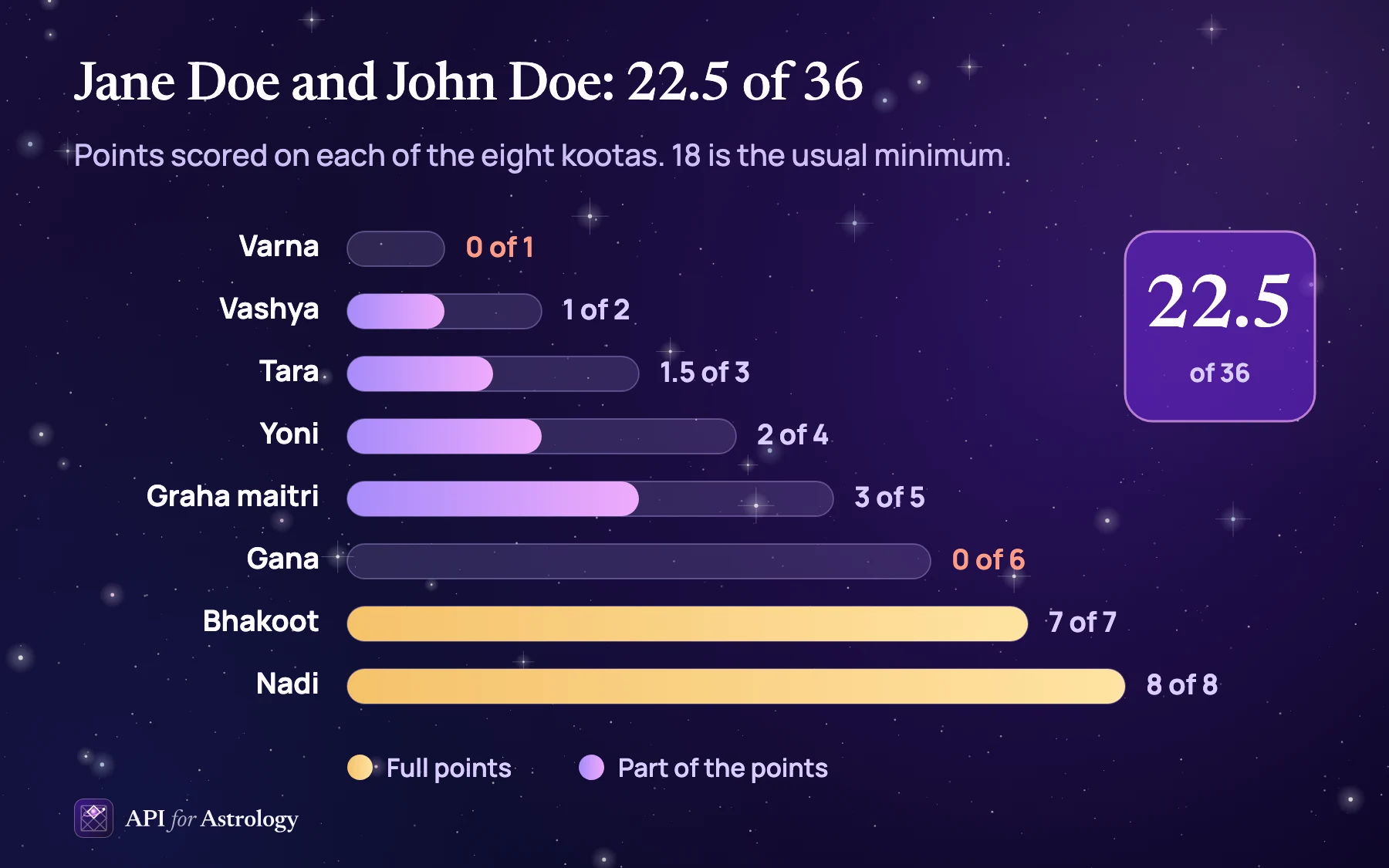
A score of 22.5 clears the usual 18. Nadi and bhakoot are both clear, so no reliefs were needed. Both charts are manglik, which the tradition reads as balancing out.
The weak spot is gana, which lost all 6 points. This is also where the one-sided nature of the scheme shows. If Jane were Deva and John Rakshasa, gana would give 1 point instead of 0. In the southern ten-check method, gana is one of the five required checks. It is the one that fails here. Eight of the ten checks agree.
One more thing stood out. Jane's chart has 8 difficult placements and John's has 7, so the papa samyam count is not balanced. That gap is small, but the tradition asks an astrologer to look at it.
How the verdict is reached
Our API sums up a match in one of three words: favorable, workable or difficult. It does this by a stated rule, not by a new score. Nothing is weighted.
Difficult if there is a serious finding: under 18 points after the reliefs, or a nadi or bhakoot dosha with no relief.
Workable if there is nothing serious but there is a concern. A concern can be a one-sided manglik, rajju, vedha or a papa samyam gap. It can also be a wedding date at the change from one main planetary period to the next.
Favorable if there is neither.
A failed southern check is noted beside the verdict but not counted in it. That is because most random pairs fail at least one. For Jane and John, the papa samyam gap is the one concern, so the verdict is workable. The full set of rules is written out in plain English in our rulebook.
Keep in mind that this is a reading of tradition. A marriage depends on far more than two Moons. No score can promise how two people will get along.
Try kundali matching yourself
Want to see your own guna milan score? Our free kundli matching tool takes two birth dates, times and places. It shows the points for each koota, the manglik comparison and the verdict with its reasons. If you are a developer, you can get the same results from the API's matching endpoint.
The manglik check sits outside the 36 points, and it has rules of its own. To see how it counts Mars from the rising sign, the Moon and Venus, read how a manglik dosha calculator works.