


A manglik dosha calculator checks one thing: whether Mars sits in house 1, 2, 4, 7, 8 or 12 of a birth chart. It counts those houses three ways: from the rising sign, from the Moon and from Venus. If any count finds Mars there, it calls the chart manglik. That is why about 88 percent of charts come out manglik under this check.
Below we show how each count works, the four classical exceptions astrologers weigh, and two worked examples. We also explain why the tradition cares more about how two charts compare than about one chart alone.
What manglik dosha means
In Vedic astrology, Mars is read as the planet of energy, drive and heat. When Mars sits in certain houses, the tradition says that heat can bring clashes into married life. That placement is called manglik dosha, also known as mangal dosha or kuja dosha.
A dosha is best read as a tendency to keep in mind, not a fixed fate. The rest of the chart decides how much it shows. That is also how our API words it in every manglik answer.
How a manglik dosha calculator checks Mars
The rule is short. A chart is manglik when Mars sits in house 1, 2, 4, 7, 8 or 12. The twist is the starting point. Houses can be counted from more than one place in the chart. Our API counts them three separate ways:
Counted from | What it is | How fast it changes |
|---|---|---|
The rising sign | The sign rising in the east at birth, called the lagna | About every two hours |
The Moon | The sign the Moon was in at birth | About every two and a quarter days |
Venus | The sign Venus was in at birth | Slowly, usually weeks per sign |
Each count is reported on its own. If any one of the three finds Mars in a manglik house, the chart is called manglik. Traditions differ here. Some astrologers count only from the rising sign, while others add the Moon and Venus. Seeing all three counts lets you, or your astrologer, apply whichever view you follow.
The rising sign changes about every two hours. So the count from it needs an exact birth time. A small error in time matters less for the Moon and Venus counts.
Why most charts come out manglik
Here is the simple math. Six of the twelve houses are manglik houses. So any one count has about a 50 percent chance of finding Mars there. Check three counts, and the odds that at least one of them finds it go up fast.
By our own count, about 88 percent of charts are manglik under this three-way check. We ran a test on 3,000 random birth moments. About half the charts were flagged from each single starting point. Close to 9 in 10 were flagged from at least one.
So if a calculator says you are manglik, you are in the large majority. That is why our answer text says plainly that this result is very common on its own.
The four classical exceptions
Classical texts list exceptions that are said to cancel or soften manglik dosha. Our API looks for four of them:
Mars in its own sign. Mars rules Aries and Scorpio, so Mars in either sign counts.
Mars exalted. Mars is exalted in Capricorn.
Mars in a Saturn-ruled kendra. Mars sits in house 1, 4, 7 or 10 from the rising sign, in a sign ruled by Saturn (Capricorn or Aquarius).
Mars as the yogakaraka. This is the planet that rules both a kendra and a trikona for the rising sign. For Mars, that happens with Cancer or Leo rising.
There is one important detail. The API reports these exceptions but never applies them. Astrologers disagree about which exceptions count and how much weight each one carries. Other texts also list more. So the chart still shows as manglik, with the exceptions named beside it. You can read the exact wording in rules DO-01 and DO-02 of our public rulebook. Why rule IDs matter explains why an answer shows its reasons and leaves the call to you.
A worked example: John Doe and Mary Smith
Here are two worked examples with sample birth details. Both results below come straight from the API.
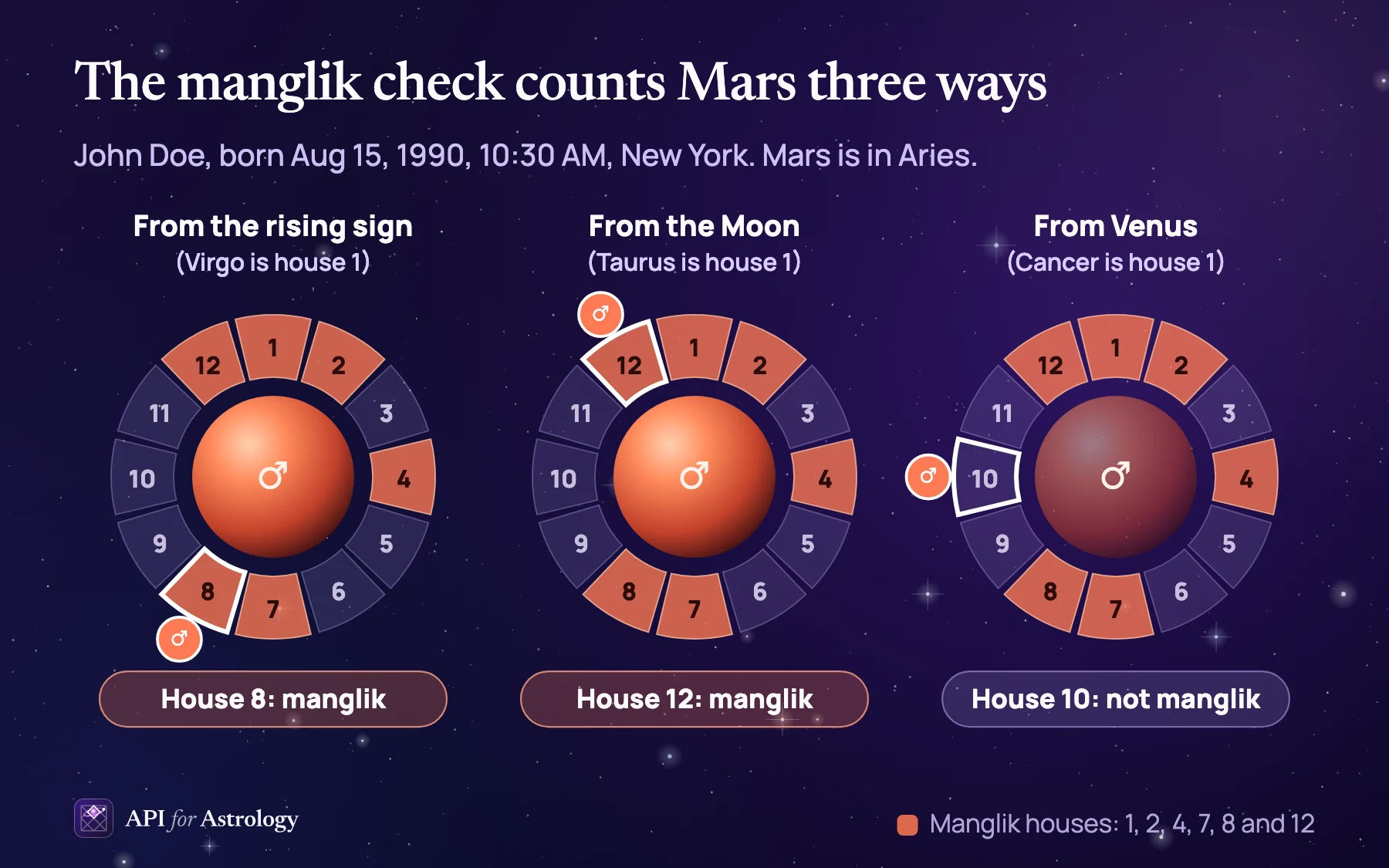
John Doe, born August 15, 1990, at 10:30 AM in New York. His rising sign is Virgo, his Moon is in Taurus, and Venus is in Cancer. Mars is in Aries.
From the rising sign, Mars is in house 8. That is a manglik house.
From the Moon, Mars is in house 12. Also a manglik house.
From Venus, Mars is in house 10. Not a manglik house.
Exception noted: Mars is in its own sign, Aries.
Mary Smith, born March 14, 1990, at 7:45 AM in Chicago. Her rising sign is Aries, her Moon is in Libra, and Venus is in Capricorn, the same sign as Mars.
From the rising sign, Mars is in house 10. Not a manglik house.
From the Moon, Mars is in house 4. A manglik house.
From Venus, Mars is in house 1. A manglik house.
Exceptions noted: Mars is exalted in Capricorn, and Mars sits in house 10 in a Saturn-ruled sign.
Both charts come back manglik, each from two of the three counts. Both also carry at least one classical exception. The answer for each says the dosha is present and names the counts that found it. It lists the exceptions. Then it adds that whether they cancel the dosha is for an astrologer to weigh.
Why the match matters more than one chart
Manglik dosha is read mainly in marriage matching. One chart on its own tells you little. The question the tradition asks is how the two partners compare:
Partner A | Partner B | How tradition reads it |
|---|---|---|
Not manglik | Not manglik | No concern from Mars |
Manglik | Manglik | Held to balance out, which the tradition accepts |
Manglik | Not manglik | The case the tradition asks an astrologer to look at |
John and Mary are both manglik, so a match between them falls in the second row. Our kundli matching tool shows this side by side. In our matching verdict, even a one-sided result is listed as a concern to discuss, not as a serious problem. The matching verdict also looks at the 36-point guna milan score and other checks. So manglik is never the whole story.
How to read your own result calmly
If your result says manglik, these points can help you keep it in perspective:
Look at which counts found it. One count out of three is not the same as all three.
Check the exceptions listed. They do not erase the result, but many astrologers give them weight.
Confirm your birth time. A wrong time can change the count from the rising sign.
Think in pairs. The match between two charts matters more than one chart alone.
If it still worries you, talk to an astrologer you trust about your whole chart.
Manglik is also only one of several doshas the tradition describes. Our page on yogas and doshas explains how the others are checked and reported.
Try the manglik check yourself
You can run the same check on your own chart with our free manglik dosha calculator. Enter a birth date, time and place to see all three counts, any exceptions, and a plain-English answer. Developers can get the same result as JSON from the POST /v1/dosha/manglik endpoint of the API.


