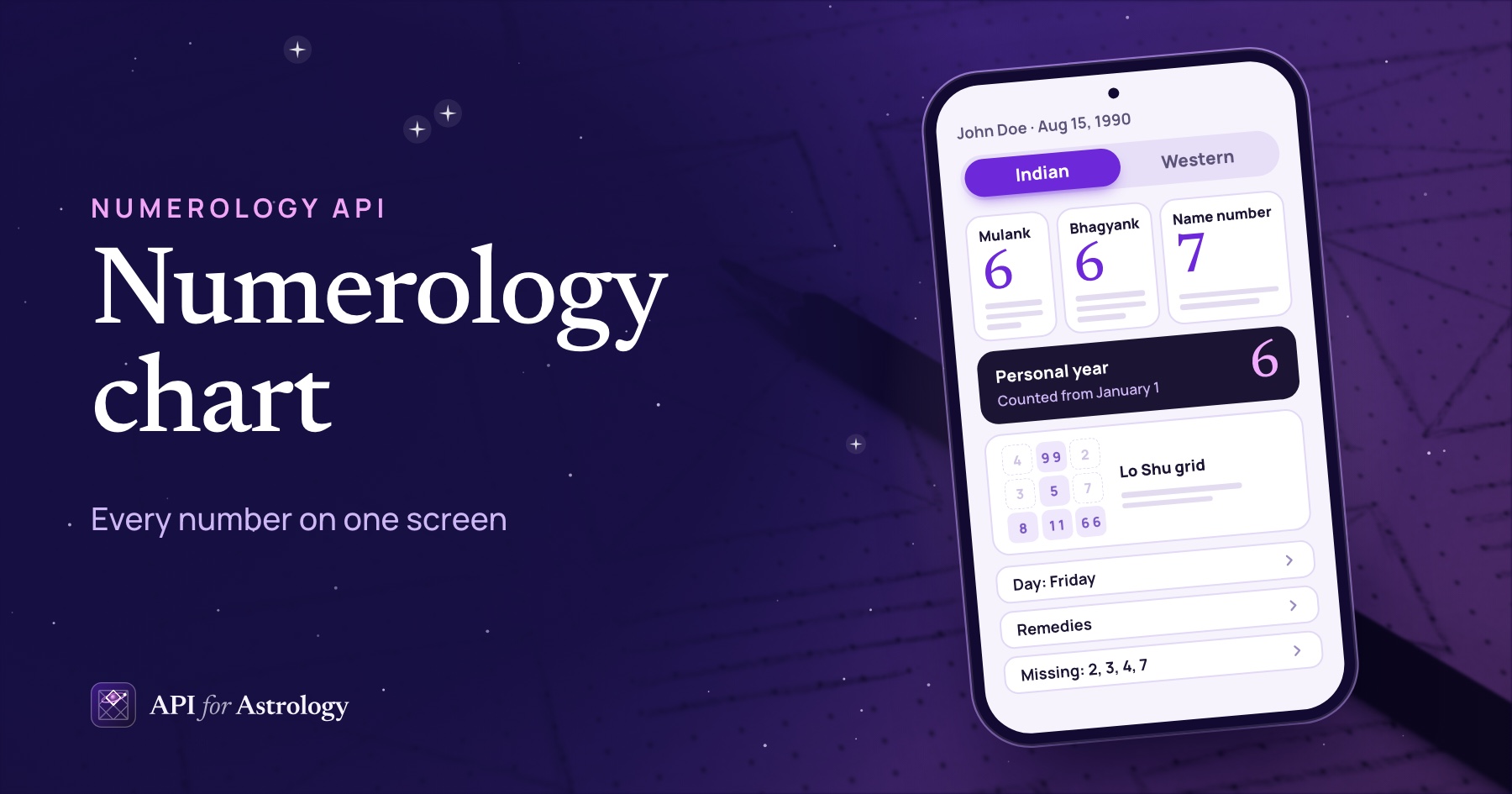
In the Indian numerology our API follows, every lucky item starts from one number: the mulank, the number of your birth day. Each mulank belongs to a planet, and that planet sets the rest. Its weekday is the lucky day. Its colors are the lucky colors. The lucky numbers are the mulank itself and the numbers whose planets its planet treats as friends. The bhagyank, which uses the whole birth date, and the name number play no part.
So a lucky number calculator built on these rules gives one answer to everyone whose birthday falls on the 6th, 15th or 24th.
Take John Doe, born Aug 15, 1990. Adding 1 + 5 gives his mulank, 6, and 6 belongs to Venus. That makes Friday his lucky day and white and pastel pink his colors. The friendly numbers of Venus, 4, 5, 6 and 8, become his lucky numbers. Venus also sets his 13 favorable dates in each month, his gemstone and his mantra.
On an app card, name the source of each item, such as "From your birth day number, 6 (Venus)." Never say an item will bring luck. End the card on the not_claimed text the API sends, so users read the items as tradition and not as a forecast.
Every example below is a real API answer from October 2026. Every share was counted on the code behind the API, over 47,847 birth dates.
What the API returns as lucky, and the number behind each item
POST /v1/profile works from a name and a birth date. Two blocks in its answer hold the lucky items, lucky and remedies. Both carry "from": "mulank", so the answer names its own source. Here are both blocks for John, and for Jane Doe (born Mar 22, 1992):
Item | Field | Set by the mulank's planet through | John Doe (mulank 6, Venus) | Jane Doe (mulank 4, Rahu) |
|---|---|---|---|---|
Lucky day |
| its weekday | Friday | Saturday |
Lucky colors |
| its colors | white, pastel pink | smoke gray |
Friendly numbers |
| the planets it counts as friends | 4, 5, 6, 8 | 4, 5, 6, 8 |
Favorable dates |
| every day from 1 to 31 whose digit sum lands on a friendly number | 13 dates | 13 dates |
Direction |
| its compass point | south-east | south-west |
Deity |
| a deity people often pray to for it | Lakshmi | Durga |
Fast day |
| its weekday again | Friday | Saturday |
Gemstone |
| its stone, metal and finger | diamond, in silver or platinum, middle finger | hessonite, in silver, middle finger |
Mantra |
| its beej (seed) mantra | the Venus mantra, 108 times a round | the Rahu mantra, 108 times a round |

Lucky numbers come as three lists. The numbers field sorts all nine numbers into friendly, neutral and unfriendly. The friendly list sits inside the lucky block, so it is what the API offers as lucky numbers. For John, 3, 7 and 9 count as neutral, while 1 and 2 come back unfriendly.
The bhagyank and the name feed nothing here. Jane's bhagyank is 1, and so is her name number. Both sit in her unfriendly list. The list follows her mulank's planet and nothing else.
Two planets borrow a day. Rahu and Ketu are not tied to any weekday, so their lucky day comes from another planet. The API gives Rahu the day of Saturn and Ketu the day of Mars, and it names that planet in day_via. Jane's answer says "day_via": "Saturn". Her color, smoke gray, is still Rahu's own.
One planet behind every lucky item
Indian numerology pairs every number from 1 to 9 with a ruling planet. The route GET /v1/guide/{number} gives the lucky items for a single number, and it needs no birth date. We called it for all nine:
Mulank | Born on | Planet | Lucky day | Lucky colors | Friendly numbers | Favorable dates a month |
|---|---|---|---|---|---|---|
1 | 1, 10, 19, 28 | Sun | Sunday | copper, deep orange | 1, 2, 3, 7, 9 | 18 |
2 | 2, 11, 20, 29 | Moon | Monday | white, pale silver | 1, 2, 5 | 11 |
3 | 3, 12, 21, 30 | Jupiter | Thursday | yellow, gold | 1, 2, 3, 7, 9 | 18 |
4 | 4, 13, 22, 31 | Rahu | Saturday, via Saturn | smoke gray | 4, 5, 6, 8 | 13 |
5 | 5, 14, 23 | Mercury | Wednesday | green, olive | 1, 5, 6 | 10 |
6 | 6, 15, 24 | Venus | Friday | white, pastel pink | 4, 5, 6, 8 | 13 |
7 | 7, 16, 25 | Ketu | Tuesday, via Mars | gray, brown | 1, 2, 3, 7, 9 | 18 |
8 | 8, 17, 26 | Saturn | Saturday | dark blue, black | 4, 5, 6, 8 | 13 |
9 | 9, 18, 27 | Mars | Tuesday | red, coral | 1, 2, 3, 7, 9 | 18 |
Nine numbers share four lists of lucky numbers. The lists rest on which planets the classical texts call friends. The Sun, Jupiter and Mars treat each other as friends, and Ketu is read as Mars. So 1, 3, 7 and 9 get the same list. Venus and Saturn are friends, and Rahu is read as Saturn. So 4, 6 and 8 share a list too. That is why John and Jane get the same friendly numbers and the same 13 dates.
Two pairs differ only in color. Mulank 4 and 8 both get Saturday, the same number lists and the same dates. So do 7 and 9, with Tuesday. Only the colors tell each pair apart.
Saturday is the most common lucky day. Across all dates from Jan 1, 1900, to Dec 31, 2030, Saturday comes back for 21.6% of birth dates. Tuesday follows at 19.7%. Friday and Wednesday get 9.9% each, since only three days of a month give mulank 5 or 6.
White is the one shared color. The Moon and Venus both list it, so 22.8% of birth dates get white among their lucky colors. Rahu is the only planet with a single color, which leaves 11.8% of dates with a list of one.
Mulank 2 has an empty list. The Moon has no enemies among the planets, which leaves mulank 2 with no unfriendly numbers. If your card shows that list, it needs a line for this case.
Why two people with the same mulank get the same lucky color
The code that builds both blocks takes one input, the mulank. It never sees the month, the year or the name. We checked this with five real calls:
Person | Birth date | Mulank | Bhagyank | Name number | Lucky day | Lucky colors |
|---|---|---|---|---|---|---|
John Doe | Aug 15, 1990 | 6 | 6 | 7 | Friday | white, pastel pink |
Jane Doe | Aug 15, 1990 | 6 | 6 | 1 | Friday | white, pastel pink |
Jane Doe | Jun 24, 1975 | 6 | 7 | 1 | Friday | white, pastel pink |
Jane Doe | Mar 22, 1992 | 4 | 1 | 1 | Saturday | smoke gray |
John Doe | Dec 31, 1975 | 4 | 2 | 7 | Saturday | smoke gray |
Within each mulank, the two blocks matched field for field. That held down to the stone, the mantra and the dates. Then we ran the profile code over every date from 1900 to 2030, 47,847 in all. Every answer's lucky and remedies blocks matched the guide for its mulank. So GET /v1/guide/6 returns John's lucky items without his birth date.
One card serves about 1 user in 8 to 10. Mulank 1 covers 13.1% of all dates, and each of mulank 5 to 9 covers 9.9%. If your users' birthdays spread like calendar days, an app with 10,000 users shows each card to 990 to 1,310 of them.
A user's own bhagyank is often missing from the list. For 53.1% of birth dates, the bhagyank is not among the friendly numbers. For 22.4%, it sits in the unfriendly list, as Jane's does. A source label on the card gives that gap its reason.
Lucky number calculator results: why the guides disagree
Other guides key their lists to other numbers, or use other planets. We read seven pages for this post. Here is what each kind would give John Doe, or the closest case the page shows:
Guide | Number it uses | Lucky color | Lucky day |
|---|---|---|---|
Our API | the birth day: 15, so 6 (Venus) | white, pastel pink | Friday |
A birth-day color list | the birth day: 15, so 6 (Venus) | pink | not given |
Two whole-date color lists | all 8 digits: 33, so 6 | indigo | not given |
A lucky number by name tool, its own example | the name "John": 20, so 2 | orange or white | Monday or Tuesday |
The whole date moves most people's colors. We ran our own planet tables on the bhagyank in place of the mulank. Over 47,847 dates, 89.0% got other colors and 84.4% got another day. Only 11.0% of dates have the same mulank and bhagyank.
A name gives yet another answer. A tool that reads letters can give a nickname and a full name different colors. In our API, John's name number is 7 (Ketu), and it changes none of his lucky items.
Some guides use other planets for 4 and 7. Three of the pages we read link 7 to Neptune, and one links 4 to Uranus. Those are Western planets. Our API uses Rahu for 4 and Ketu for 7. One page names Monday as the main day for 7, with Sunday and Wednesday after it. Ours returns Tuesday, because it reads Ketu as Mars.
Another numerology API adds things we leave out. Its docs show a person born on the 24th, which is mulank 6. Its lucky day is Friday, like ours. Its lucky numbers are 3, 6, 9 and 2, with 1 to avoid, where our API counts 2 as unfriendly for mulank 6. It lists blue, pink and green, plus a color to avoid. It also marks four months of the year for poor health. Our API gives no color to avoid and no health months.
Letter tables, master numbers and the other splits between calculators are covered in why two numerology calculators give different numbers.
Gemstone, mantra and the other remedies, handled with care
The remedies block follows the same planet. For John, that means south-east, Lakshmi, a Friday fast, a diamond and the Venus mantra. The fast day is always the lucky day, since both come from one table. The API reports what tradition links to the planet, and it makes no promise that a remedy works.
Every gemstone comes with a note. Each numerology gemstone in the answer has an about line. It says the numbers cannot settle the question of wearing the stone, and it points users to an astrologer and their birth chart. John's diamond has this line and nothing more.
Three stones carry a caution as well. Blue sapphire, for mulank 8, has a caution of its own. It says the classical books single this stone out, and people often wear it briefly before having it set. Hessonite for 4 and cat's eye for 7 are the stones of Rahu and Ketu. Jane's hessonite comes with this caution from the API:
"This stone is for Rahu or Ketu, not for a sign ruler. Tradition treats it as a stone for a period of life, not for all of it."
Here, a sign ruler means a planet that rules a zodiac sign. Mulank 4, 7 and 8 together cover 31.5% of birth dates, so about 1 card in 3 needs room for a caution.
Mulank 7 gets no direction. The classical list names a compass point for eight planets only, and it leaves Ketu out. So direction comes back null for 9.9% of birth dates, with a direction_about line saying why. Ketu's beej mantra also has two full counts in the books, 17,000 or 7,000. A japa_note says which one the answer shows.
Outside guides promise more. One birth-date crystal list we read pairs the 6th, 15th and 24th with rose quartz, where ours gives diamond. It says citrine, its stone for 3, adds to wealth. Our API gives yellow sapphire for 3, and its note makes no claim about money or health.
The Lo Shu grid does not change any of this. A missing number in the grid leaves the remedies as they are. Our post on missing numbers and lines in the Lo Shu grid shows what the API gives for a gap there.
How to show lucky things on an app card
Say where each item comes from. Head the card "From your birth day number, 6 (Venus)", built from mulank.number and lucky.planet_name. Every lucky item has that one source, so one label covers the card. It also explains to Jane why her bhagyank is not on her list.
Use the words of tradition, not of results. Write "linked to" or "tradition pairs". Never write "guaranteed" or "will bring luck". Show dates_about beside the dates. It says such dates tend to suit starting things, and goes no further.
End with the not_claimed line. Every profile answer includes not_claimed. That field says numbers hint at tendencies and decide nothing. Put it at the foot of the card, in the reader's language.
Key on codes, show names. Use day, color and planet for logic. Put day_name, name and planet_name on screen. The codes stay the same in every language:
Field | Code |
|
|
|---|---|---|---|
John's day |
| Friday | शुक्रवार |
John's colors |
| white, pastel pink | सफ़ेद, हल्का गुलाबी |
Jane's day |
| Saturday | शनिवार |
Jane's color |
| smoke gray | धुएँ जैसा सलेटी |
John's stone |
| Diamond (heera) | हीरा |
Leave the code spellings alone. Rahu's color code is smoke grey, with an e, while its English name is "smoke gray". Match swatches on the code as it is, and show the name.
Plan for the short and empty cases. Rahu has one color, so a color list may have a single entry. Mulank 4 and 7 return a day_via, on 21.6% of birth dates, so add a small note for the borrowed day. Mulank 7 returns no direction, so show its direction_about line in that spot.
Treat the dates as a pattern, not a calendar. The favorable dates in lucky.dates repeat in every month, since the month never enters the sum. For one real month, POST /v1/dates checks every date in full against the person.
Find the number behind the card. The free numerology calculator on our site finds all three core numbers, the mulank among them, for any name and birth date. It uses the same POST /v1/profile route, and its mulank is the number every lucky item comes from.
The code: building the lucky card
Below is Jane Doe's request, then the lucky part of her answer with the longer text lines left out. New to the API? The first request is walked through in our guide to mulank, bhagyank and name number.
Jane Doe, born Mar 22, 1992
{
  "name": "Jane Doe",
  "birth_date": "1992-03-22"
}
{
"mulank": { "number": 4, "planet": "Rahu", "planet_name": "Rahu" },
"lucky": {
"from": "mulank",
"planet": "Rahu",
"planet_name": "Rahu",
"day": "Saturday",
"day_name": "Saturday",
"day_via": "Saturn",
"colors": [{ "color": "smoke grey", "name": "smoke gray" }],
"numbers": {
"friendly": [4, 5, 6, 8],
"neutral": [3],
"unfriendly": [1, 2, 7, 9]
},
"dates": [4, 5, 6, 8, 13, 14, 15, 17, 22, 23, 24, 26, 31]
},
"remedies": {
"from": "mulank",
"gemstone": { "stone": "hessonite", "stone_name": "Hessonite (gomed)", "metal": "silver", "finger": "middle" }
}
}This JavaScript function turns a profile answer into the card. Each item keeps the API's own words, and the card ends with not_claimed. We ran it on all 9 profile answers saved for this post, in English and Hindi, and every card passed.
// The "lucky things" card, from one POST /v1/profile answer.
// Every item says where it comes from, so the card reads as tradition, not a promise.
export function luckyCard(answer) {
  const { mulank, lucky, remedies } = answer;

  const items = [
    { key: "day", label: "Day", value: lucky.day_name },
    { key: "colors", label: "Colors", value: lucky.colors.map((color) => color.name).join(", ") },
    { key: "numbers", label: "Friendly numbers", value: lucky.numbers.friendly.join(", ") },
    { key: "dates", label: "Dates in any month", value: lucky.dates.join(", "), note: lucky.dates_about },
    {
      key: "gemstone",
      label: "Gemstone",
      value: remedies.gemstone.stone_name,
      // The about line always comes; a caution comes only for some stones.
      note: [remedies.gemstone.about, remedies.gemstone.caution].filter(Boolean).join(" "),
    },
  ];

  return {
    source: `From your birth day number, ${mulank.number} (${lucky.planet_name})`,
    items,
    closing: answer.not_claimed,
  };
}
For Jane, the card's source line reads "From your birth day number, 4 (Rahu)". Her gemstone note holds both the about line and the Rahu caution. With lang=hi, the values arrive in Hindi. The labels and the words of the source line stay in English, so translate those in your app.
The request goes to https://apiforastrology.com/api/numerology/v1/profile and takes 3 reading credits. To build a page for one number, with no person, call GET /v1/guide/{number}. It also takes 3 credits, and its answer lists born_on: every day of a month that adds down to that number.
See one number's full set. The mulank 6 page lists every lucky item and remedy for Venus's number, from the lucky day to the mantra. The core numbers API page shows the rest of the profile answer.

The short version
In the Indian numerology our API follows, every lucky item traces back to the birth day number and its planet. The day, colors, friendly numbers, dates, stone and mantra all follow from that one planet. Anyone with a birthday on the 15th gets the same card, whatever the year or name. Other guides use the whole date, the name or Western planets, so their lists differ. On the card, name the source and keep the API's notes beside each item.