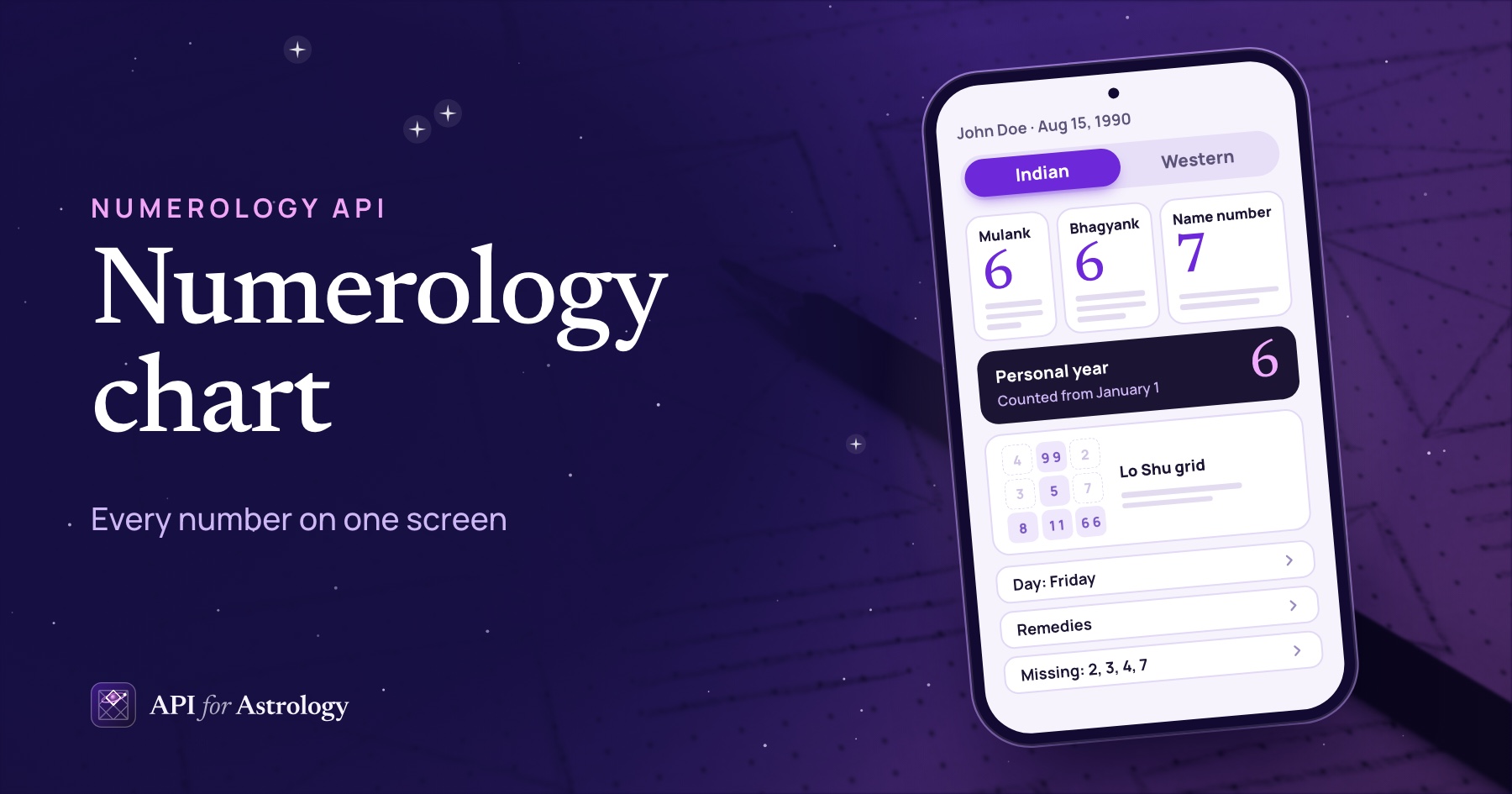
Your user types John Doe, born Aug 15, 1990, into two apps. One says his name number is 7. The other says 8. Both apps did the math right. They just followed different rules.
Numerology comes from more than one tradition, and each calculator picks its own rules. Every numerology calculator makes seven choices before it shows a number. It picks a letter table and a form of the name. It decides whether to keep master numbers (11, 22 and 33) and how to add the date. It also picks how to read the birth day and whether to show the two-digit total. And it picks what goes into the Lo Shu grid, a 3 by 3 square of the date's digits. Change one choice, and the same person gets a new number.
For John, our API returns a name number of 7 with the Indian (Chaldean) letter table. The Western (Pythagorean) table gives 8. His first name alone gives 9. The digits of his birth date add up to 33. One rule shows that as 33, and another shows 6.
So the fix is not a better formula. Pick one method, name it on screen, show the working, and explain it in a help screen. Below, each choice gets a real example from our API, run in October 2026. We also measured how often the methods split across 47,847 birth dates.
Why numerology calculators disagree: seven choices
Each row below is a real answer for one of our two sample people. John Doe was born Aug 15, 1990, and Jane Doe was born Mar 22, 1992.
Choice | Example | One rule gives | Another rule gives |
|---|---|---|---|
Letter table | John Doe | 7 (Chaldean) | 8 (Pythagorean) |
Which name | John Doe or John | 7 (full name) | 9 (first name only) |
Master numbers | Jon Doe, total 29 | 2 (reduced) | 11 (kept) |
Adding the date | Aug 15, 1990 | 6 (month, day and year first) | 33 (all digits at once) |
Two-digit birth day | Jane Doe, the 22nd | 4 (mulank) | 22 (birthday number) |
Lo Shu grid | Aug 15, 1990 | 6 shows twice | 6 is missing |
Compound number | John Doe, total 34 | 7 (single digit) | 34 (compound) |
1. The letter table: Chaldean or Pythagorean
A name number gives each letter a value and adds the values up. Two letter tables are common. The Chaldean table is the one Indian numerology uses most, and no letter in it is worth 9. The Pythagorean table gives the letters 1 to 9 in alphabet order. Most Western numerology books and apps use it.
For John Doe, only two letters change value: O and H.
Table | J | O | H | N | D | O | E | Total | Number |
|---|---|---|---|---|---|---|---|---|---|
Chaldean | 1 | 7 | 5 | 5 | 4 | 7 | 5 | 34 | 7 |
Pythagorean | 1 | 6 | 8 | 5 | 4 | 6 | 5 | 35 | 8 |
We ran the 13,859 first names in our baby name list through both tables. The single number differed for 89.0% of them, about 9 names in 10. Our post on Chaldean vs Pythagorean numerology shows what changes in the code.
2. Which name: full, first, nickname or spelling
Every letter counts, so the form of the name matters as much as the table. We sent John's birth date with four forms of his name, all read in the Chaldean table.
Name sent | Letter totals | Total | Name number |
|---|---|---|---|
John Doe | 18 + 16 | 34 | 7 |
John | 18 | 18 | 9 |
Johnny Doe | 24 + 16 | 40 | 4 |
Jon Doe | 13 + 16 | 29 | 2 |
One person, four numbers. The two traditions also ask for different names. The Indian name number reads the name a person writes and uses. Western numbers, such as the expression number, read the full name from birth.
Our API reads the name exactly as sent, in English letters. It never guesses a spelling. It also returns each word on its own in words, because some readings use the first name alone. Show the name you read right next to the number.
3. Master numbers: kept or reduced
To reduce a number, you add its digits until one digit is left. Master numbers are 11, 22 and 33. Western numerology keeps them instead of reducing them.
Take the spelling Jon Doe. Its letters add up to 29, and 2 + 9 = 11. An app that keeps master numbers stops there and shows 11. An app that reduces goes one step more: 1 + 1 = 2.
Our API follows each tradition. Indian numbers always end on one digit, so Jon Doe gets 2 with master set to true. Western numbers keep 11, 22 or 33 in number, with the single digit beside it in digit. Show the flag, and a user who saw 11 somewhere else can see where it went.
4. How the date is added
A numerology calculator can add a date of birth in more than one order. For the life path number, our API reduces the month, the day and the year one at a time, then adds them. The answer says so in basis.life_path.
Here is John's date three ways, with master numbers kept:
Method | Working | Result |
|---|---|---|
Month, day and year first (our API) | 8 + 6 + 1 = 15, and 1 + 5 = 6 | 6 |
All digits at once | 0 + 8 + 1 + 5 + 1 + 9 + 9 + 0 = 33 | 33 |
Whole numbers | 8 + 15 + 1990 = 2013, and 2 + 0 + 1 + 3 = 6 | 6 |
These methods can split only on a master number. Adding digits in any order never changes the final single digit. We checked every date from Jan 1, 1900, to Dec 31, 2030, which is 47,847 dates. All three methods reached the same single digit every time.
With master numbers kept, the first two methods split on 6,631 dates, or 13.9%. John's date is one of them. Our post on how the life path number is worked out goes through each step.
5. The birth day: mulank or birthday number
Indian and Western numerology both read the day of birth, but in different ways. The mulank (birth day number) always ends on one digit. The Western birthday number keeps a master number.
Jane Doe was born on Mar 22, 1992. Her mulank is 2 + 2 = 4. Her birthday number stays 22. Only three days of the month split this way. They are the 11th (2 or 11), the 22nd (4 or 22) and the 29th (2 or 11).
One more detail matters for Indian apps. Our API uses the calendar date as typed. It does not start the day at sunrise, so it needs no birth time.
6. The Lo Shu grid: what goes in
The Lo Shu grid is a 3 by 3 square of the numbers 1 to 9. Each digit of the birth date goes into its cell, and zeros are dropped. Books differ on the next step: whether to add the bhagyank (destiny number) and the mulank.
Our API adds the bhagyank, plus the mulank when the birth day has two digits. It lists each digit and where it came from in loshu.placed. A line is three cells in a straight row, column or diagonal. It is read only when all three cells are filled or all three are empty. Here is what the rule does to John's grid:
Rule | Times 6 shows | Missing numbers | Full lines |
|---|---|---|---|
Date digits only | 0 | 2, 3, 4, 6, 7 | Willpower (9, 5, 1) |
Date, plus bhagyank 6 and mulank 6 (our API) | 2 | 2, 3, 4, 7 | Willpower, and practical (8, 1, 6) |
The two rules gave a different list of missing numbers for 68.3% of the 47,847 dates we checked. Our post on how the Lo Shu grid is built shows every step. The free Lo Shu grid calculator draws the grid for any date.
7. Compound numbers: 34 or 7
A compound number is the two-digit total before it is reduced. Chaldean compound tables run from 10 to 52, and each total has its own reading. John Doe's letters add up to 34. So one app may show 34 with a reading for 34, while another shows 7.
Our API returns the compound number in compound, next to the single digit in number. It does not read compound numbers yet, and the profile says so in not_included. Every reading comes from the single digit. So show 34 as a plain fact, and read 7.

What your app should do about it
You cannot make every app agree. You can make yours easy to check, with four habits.
Name the system. Put the tradition on screen, such as "Chaldean name number" or "Pythagorean expression number". Our answers carry it in system, and the profile adds system_name for display.
Show the working. Print the sum, not just the result: John 18 + Doe 16 = 34, and 3 + 4 = 7. The API returns the parts you need in words, total, parts, master and digit.
Keep one method. Do not mix tables or rules across screens. If you show Indian and Western numbers, label them as two sets. Our API never mixes the two systems in one number.
Explain it in a help screen. One short page lets users check the math for themselves. Here is wording you can adapt: "Your numbers follow Indian numerology. Your name number uses the Chaldean letter table. Other apps may use another table or keep 11, 22 and 33, so their numbers can differ. Numbers show leanings, not fixed events."
The main rules our API follows, from the letter tables to the Lo Shu grid, sit on one page. Link your help screen to the numerology conventions so users can see the method behind each number.

Get both sets of numbers from the API
Send a name and a birth date to POST /v1/profile for the Indian numbers and the Lo Shu grid. Send the same body to POST /v1/western for the Western numbers. Here is the request for John Doe, born Aug 15, 1990:
{
  "name": "John Doe",
  "birth_date": "1990-08-15"
}
Part of the profile answer, with the readings left out:
{
  "mulank": { "number": 6, "planet": "Venus" },
  "bhagyank": { "number": 6, "total": 33, "master": true },
  "name_number": {
    "chaldean": { "system": "chaldean", "total": 34, "compound": 34, "number": 7, "master": false },
    "pythagorean": { "system": "pythagorean", "total": 35, "number": 8, "read": false }
  },
  "loshu": {
    "basis": "Non-zero digits of the birth date (DD MM YYYY), plus the bhagyank, plus the mulank when the day has two digits. Zero has no cell."
  }
}
Part of the Western answer for the same body:
{
  "system": "pythagorean",
  "basis": {
    "masters": "11, 22 and 33 are kept; `digit` is the same number reduced to 1-9.",
    "life_path": "Month, day and year are reduced one by one, then added."
  },
  "life_path": { "parts": { "month": 8, "day": 6, "year": 1 }, "total": 15, "number": 6, "digit": 6 },
  "expression": { "words": [20, 15], "number": 8 }
}
The basis lines state the method in plain words. Put them in your help screen, and users can see why another app shows something else. The Western numbers feature shows the rest of what that route returns.
Try any name and date in the free numerology calculator, then compare it with the answer above. For every field, see the API reference.

Every split in this post came from a rule, not a math error. A rule can be named and shown. Do that, and "another app gave me a different number" has a clear answer.