A life path number comes from the whole birth date, and our API works it out in three steps. First, reduce the month, the day and the year one by one. To reduce a number means to add its digits until one digit is left. The exceptions are 11, 22 and 33, called master numbers, which are kept as they are. Then add the three parts and reduce the total the same way.
John Doe was born on Aug 15, 1990. His month gives 8. His day, 15, gives 1 + 5 = 6. His year, 1990, adds up to 19, then 10, then 1. So 8 + 6 + 1 = 15, and 1 + 5 = 6. His life path number is 6, and that is what POST /v1/western returned for him.
Other numerology guides add up the same date in two more ways. One adds every digit at once: 0 + 8 + 1 + 5 + 1 + 9 + 9 + 0 = 33. That method gives John the master number 33. So two calculators can tell one person 6 and 33.
We ran all three methods on every date from Jan 1, 1926, to Dec 31, 2025. The single digit at the end never changed. But the master number or the karmic debt changed on 46.52% of those dates.
How to calculate a life path number, step by step
The life path is the Western number built from the whole birth date. Numerology reads it as the general road a life follows. It belongs to Pythagorean numerology, the Western system.
Here is John's date, worked the way the API works it:
Part | Working | Result |
|---|---|---|
Month | August is the 8th month | 8 |
Day | 15 → 1 + 5 | 6 |
Year | 1990 → 1 + 9 + 9 + 0 = 19 → 1 + 9 = 10 → 1 + 0 | 1 |
Life path | 8 + 6 + 1 = 15 → 1 + 5 | 6 |
A master number stops the adding at any step. A day of 29 gives 2 + 9 = 11, and the 11 stays. A day of 22 stays 22.
A master number in one part does not make the whole life path a master number, though. Jane Doe was born on Mar 22, 1992. The API keeps 22 for her day. Her parts are 3, 22 and 3, which add up to 28. Then 2 + 8 = 10, and 1 + 0 = 1. Her life path number is 1.
The two other methods in numerology guides
Numerology guides and calculator sites show two more ways to add up a date. We worked both out in our own script, not in the API, and label them as the guides' methods.
Method | Where it comes from | John Doe, Aug 15, 1990 | Life path |
|---|---|---|---|
Reduce each part first | Our API | 8 + 6 + 1 = 15 → 6 | 6 |
Add all digits at once | Other guides (our script) | 0 + 8 + 1 + 5 + 1 + 9 + 9 + 0 = 33 | 33 |
Add whole numbers | Other guides (our script) | 8 + 15 + 1990 = 2013 → 6 | 6 |
All three methods stop at 11, 22 or 33 when they meet one. So the only change is the order of adding.

Why every method ends on the same digit
The order of adding cannot change the last digit. Adding the digits of a number keeps its remainder after dividing by 9. So every order ends on the same digit from 1 to 9. John's 33 reduces to 6, just like his 15 and his 2013.
What changes is the two-digit number met on the way. Master numbers and karmic debt numbers are both two-digit numbers, so that is where calculators split.
Dates where the methods give different answers
On John's date, the all-digits method finds a master number and the API does not. For a birth on Aug 11, 1992, it is the other way around:
Method | Working | Life path |
|---|---|---|
Reduce each part first (API) | 8 + 11 + 3 = 22 | 22 |
Add all digits at once (guides) | 0 + 8 + 1 + 1 + 1 + 9 + 9 + 2 = 31 → 4 | 4 |
Add whole numbers (guides) | 8 + 11 + 1992 = 2011 → 4 | 4 |
The API keeps the day as 11, so the parts land on 22 exactly. Its answer has number 22 and digit 4. The guides' methods add the day's two 1s on their own and never meet 22.
How often the three methods disagree
Most dates still agree, as Jane Doe's does: all three methods give her 1. Here is the count for all 36,525 dates in the 100 years we checked:
What we counted, Jan 1, 1926, to Dec 31, 2025 | Dates | Share |
|---|---|---|
The single digit differs between methods | 0 | 0% |
All three methods give the same life path | 28,718 | 78.63% |
The API and the all-digits method differ | 4,692 | 12.85% |
The API and the whole-number method differ | 4,673 | 12.79% |
The life path or its karmic debt differs | 16,991 | 46.52% |
Take the master number 33. The all-digits method gives a life path of 33 on 1,738 dates. The API gives 33 on 284 dates. The whole-number method never gives 33, because its sums are near 2,000, and their digits add up to 28 at most.
We checked our script against the core's own code on every one of those dates, and against 200 real API calls. Every answer matched.
Karmic debt on the way: 13, 14, 16 and 19
Western numerology gives 13, 14, 16 and 19 a special name when they appear on the way to a number: karmic debt. Each one is read as a lesson to work on. The API makes no claim about past lives, and every Western answer says so in not_claimed_karmic.
The order of adding decides whether a debt number shows up. Take a birth on Mar 9, 1990:
Method | Working | Life path | Karmic debt |
|---|---|---|---|
Reduce each part first (API) | 3 + 9 + 1 = 13 → 4 | 4 | 13 |
Add all digits at once (guides) | 0 + 3 + 0 + 9 + 1 + 9 + 9 + 0 = 31 → 4 | 4 | none |
Add whole numbers (guides) | 3 + 9 + 1990 = 2002 → 4 | 4 | none |
All three give 4, but only the API's method passes through 13. Over the 100 years, the API's method finds a debt number on 24.69% of dates. The all-digits method finds one on 8.09%, and the whole-number method on 11.56%.
The API checks the sum of the three parts and each step down from it, not the inside of a part. So John's year, which passes 19 on its way to 1, adds no debt. A birth day of 13, 14, 16 or 19 is listed on the birthday number instead. For Jan 19, 2000, the life path is 1 + 1 + 2 = 4 with no debt, and the birthday block lists 19.
Want to test a date before you write any code? Our free life path number calculator calls the same POST /v1/western route. It shows the month, day and year parts, so you can follow every step.

What the API returns for the life path
Send a full name and a birth date to POST /v1/western, with no birth time or place. Here is the request for John Doe, born Aug 15, 1990:
{
  "name": "John Doe",
  "birth_date": "1990-08-15"
}
Here is the life path part of the answer. The basis lines name the method, so your app can show it too:
{
  "system": "pythagorean",
  "basis": {
    "life_path": "Month, day and year are reduced one by one, then added.",
    "masters": "11, 22 and 33 are kept; `digit` is the same number reduced to 1-9."
  },
  "life_path": {
    "total": 15,
    "number": 6,
    "digit": 6,
    "karmic_debt": [],
    "parts": { "month": 8, "day": 6, "year": 1 },
    "reading": "Your road tends to center on caring for others. Family, home and community often matter most to you."
  }
}
Field | John Doe | What it holds |
|---|---|---|
| 8, 6 and 1 | The month, day and year, each reduced, with master numbers kept |
| 15 | The three parts added up |
| 6 | The life path, with 11, 22 or 33 kept |
| 6 | The same number reduced to 1 to 9 |
| empty | Each of 13, 14, 16 or 19 met, with its number and a reading |
For Mar 9, 1990, karmic_debt holds one item: the number 13, with its reading. With lang=hi, the numbers stay the same and only the words change to Hindi.
What your app should show
Show the working. The parts and total fields let a user follow the sum. When a user says another app gave 33, the working shows where the two counts split.
Choose `number` or `digit` on purpose. The number field keeps master numbers, and digit is always 1 to 9. You can also print both, such as 22/4 for Aug 11, 1992. Use the same choice on every screen.
The choice also reaches other numbers. The maturity number adds the life path to the expression number. For John, the API adds 6 + 8 = 14, then 5, and lists karmic debt 14. A life path of 33 would give 33 + 8 = 41, then 5, with no 14. The pinnacles, four long life stages, use only the digit. So their ages stay the same under all three methods.
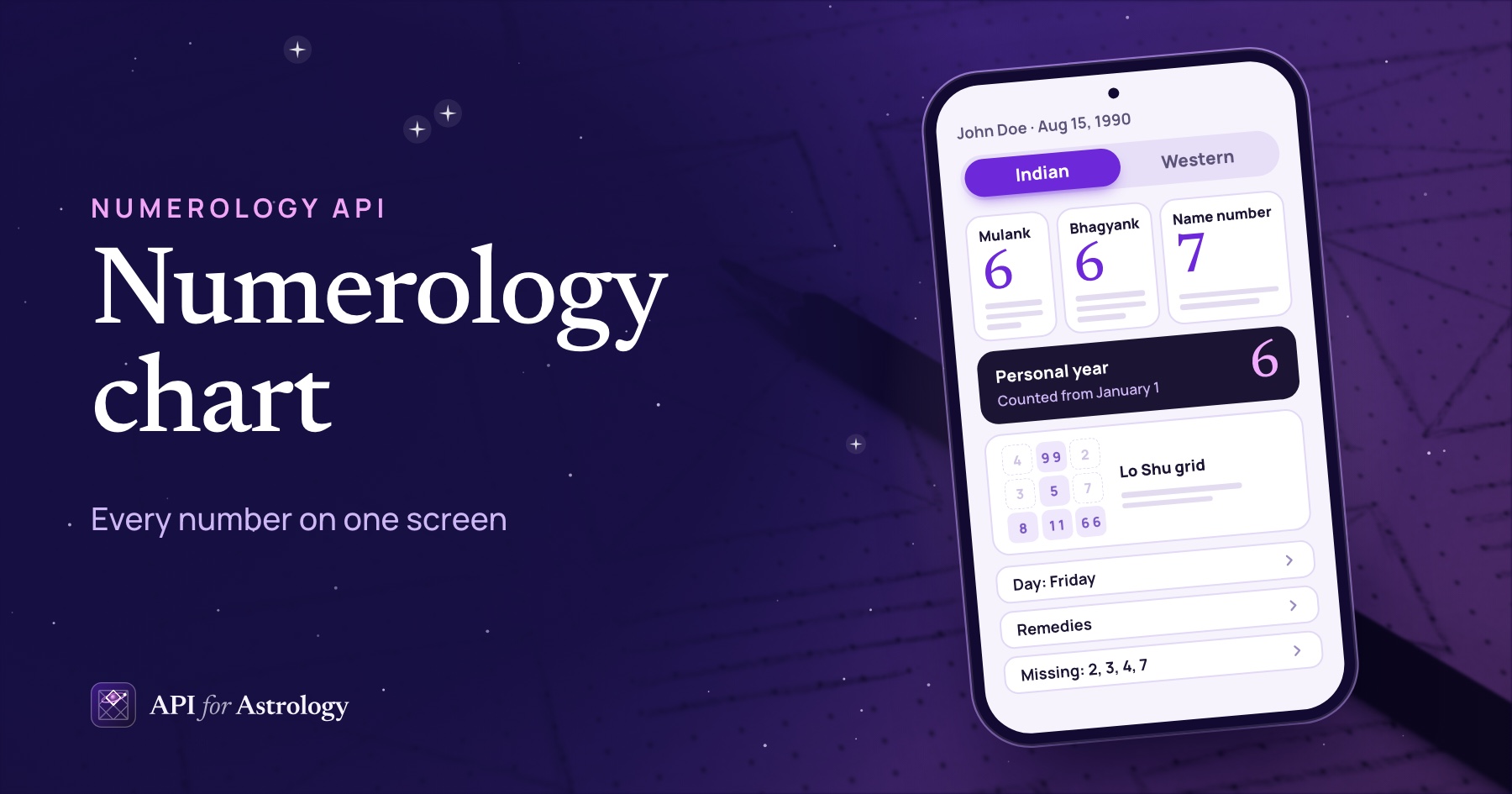
Keep the life path apart from one more number. POST /v1/profile returns the Indian bhagyank, or destiny number, from the same date. It adds every digit at once, so John's bhagyank total is 33. It ends on 6, with master set to true. If one screen shows both numbers, label them as two systems. Our post on mulank, bhagyank and name number shows how the Indian numbers add up.
To see every Western number in one answer, read what the Western numbers API returns. Each field and its type is in the API reference.

Every life path method lands on the same last digit. They part ways only on the two-digit numbers along the route, and those carry the master numbers and the karmic debt. So pick one method, and let the working on the screen show which one it is.