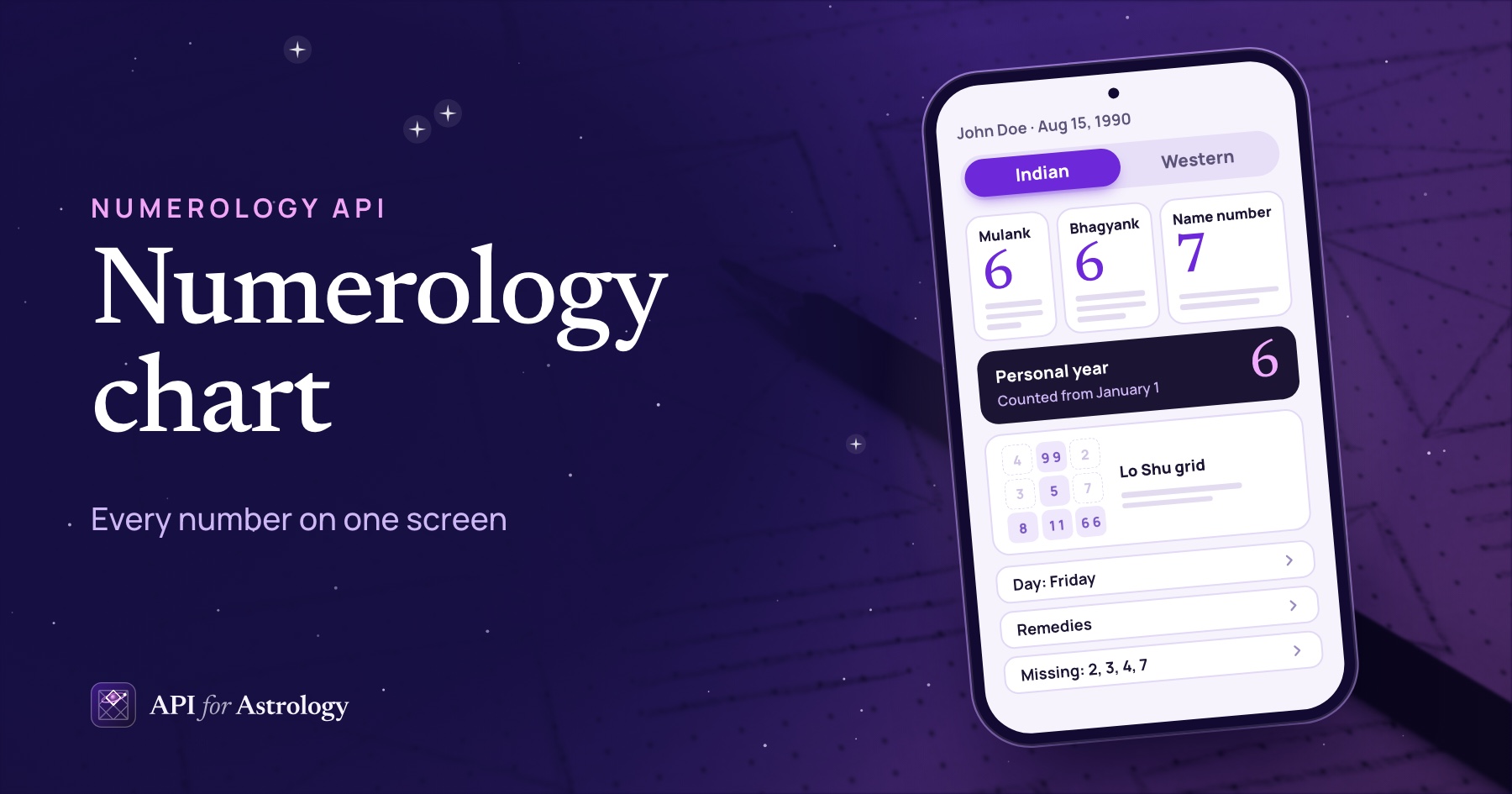

Is the destiny number the same as the bhagyank? Only in Indian numerology. There, "destiny number" is the English name for the bhagyank. It sums all eight digits in a birth date and cuts the total down to a single digit. Many Western guides use the same two words for another number. They mean the expression number, which sums the letters of the whole birth name. A few Western guides give the name to the life path, another number worked out from the date.
So one label can stand for two formulas. John Doe, born Aug 15, 1990, shows it. His bhagyank is 6. His life path is 6 too. His expression number is 8. A user who asks your app for a destiny number could expect a 6 or an 8.
Pick the formula by the screen, not by the word. On an Indian numerology screen, show the bhagyank from POST /v1/profile. On a Western screen, show the expression number, which POST /v1/western returns, under its own name. Never print "destiny number" on its own. Tell the user which input made it: the birth date or the birth name.
Where the name destiny number comes from
Bhagyank is a Hindi word in two parts. Bhagya means fortune, fate or destiny, and ank means number. So "destiny number" is a word-for-word English version, and Indian numerology pages use it that way.
Western numerology uses the same term for a different number. Its guides give it to a name-based number, the one also called the expression number. We read eight numerology pages on October 19, 2026, to see how each one uses the term:
Pages we read | What "destiny number" means there | What it is worked out from |
|---|---|---|
4 Indian numerology pages | The bhagyank. Two of them also call it the life path number | The full birth date |
3 Western numerology pages | The expression number | All the letters of the whole birth name |
1 Western numerology page | The life path, written as "Destiny/Life Path" | The full birth date |
None of the eight pages warns that the term means another number in the other tradition. That is fine for a page that serves one tradition. An app with users in Mumbai and in New York serves both, so the two meanings land on the same screens.
John Doe's destiny number, three ways
Here are all three meanings for John Doe, from our API's answers on October 19, 2026. Reducing a number means summing its digits, and summing again, until only one digit stays.
Meaning of "destiny number" | Formula | John Doe's working | Result | Route and field |
|---|---|---|---|---|
Bhagyank (Indian) | Every digit of the date, reduced to 1 to 9 | 1 + 5 + 0 + 8 + 1 + 9 + 9 + 0 = 33, then 3 + 3 | 6 |
|
Life path (a few Western guides) | Month, day and year reduced on their own, then added | 8 + 6 + 1 = 15, then 1 + 5 | 6 |
|
Expression (many Western guides) | All letters of the birth name, in Pythagorean values | John 20 and Doe 15 reduce to 2 and 6, then 2 + 6 | 8 |
|
The expression number uses the Pythagorean letter values. Letters A through I count 1 through 9, and J restarts the count at 1. The life path and the expression keep 11, 22 and 33, the master numbers, whole. The bhagyank is always a single digit.
The same split holds for Jane Doe, born Mar 22, 1992. Her date gives a bhagyank of 1 from a total of 28, and a life path of 1. Her name gives an expression number of 9. For both sample people, the two date answers agree and the name answer stands apart.

The bhagyank sum is worked digit by digit in our guide to the three Indian core numbers. The Western date sum can be added in three common orders, and our life path post compares them.
How often the date and the name give different numbers
Two people make a small sample. So we ran the same functions the API runs over every birth date in 100 years: Jan 1, 1926, through Dec 31, 2025. That is 36,525 dates. Before counting, the script checked itself against the API answers for John, Jane and one more date. All three matched.
The two date meanings end on the same single digit on every date. The bhagyank and the life path add the same digits, only in a different order. Changing the order of the adding never changes the single digit you end on. On all 36,525 dates, the life path's digit matched the bhagyank.
They still show different numbers on 3,771 dates, or 10.3%. On each of those dates, the life path keeps a master number (11, 22 or 33) and the bhagyank reduces it. Mar 7, 1990, is one of them. Its life path is 11, and its bhagyank is 2, from a total of 29. Our master numbers post counts 11, 22 and 33 one by one.
The name meaning splits from the date far more often. Each of the 13,859 first names on the core's name list got the surname Doe. Then we paired every name with every date, for 506,199,975 name and date pairs. The expression number differed from the bhagyank on 90.2% of them. With master numbers reduced to one digit, it still differed on 88.9%.
Two meanings compared | Same single digit at the end | Same number on the screen |
|---|---|---|
Bhagyank and life path, both from the date | 100% of dates | 89.7% of dates |
Bhagyank and expression, date against name | 11.1% of pairs | 9.8% of pairs |
The bhagyank lands on each number from 1 to 9 almost evenly, on 4,057 to 4,060 of the dates each. A number from a name has no link to the date. So it meets the bhagyank about 1 time in 9, by chance alone. John Doe's own name shows it: his expression is 8, and only 11.1% of the dates give a bhagyank of 8.
So suppose one app reads "destiny number" as the date and another reads it as the name. For about 9 name and date pairs in 10, the two apps show the same person two different numbers. Both apps are right by their own rules.
What the API calls each number
Neither answer has a field named destiny. Each number has its own field, and each one comes with an about line naming its input. In the API's English text, the word destiny appears only beside the bhagyank. Here is John Doe's bhagyank from POST /v1/profile, trimmed to the fields that matter for a label.
John Doe, born Aug 15, 1990. Trimmed answer from POST /v1/profile
{
  "bhagyank": {
    "number": 6,
    "total": 33,
    "master": true,
    "planet": "Venus",
    "about": "Your bhagyank (destiny number) comes from your full birth date. It shows the direction your life tends to take as you grow older."
  },
  "not_included": {
    "western_numbers": "Life path, expression, soul urge, pinnacles, life cycles and the personal year come from the western route."
  }
}
The about line uses the Hindi word first and the English name after it, in brackets. It also names the input: the full birth date. The not_included block points to the Western route for both the life path and the expression.
John Doe, born Aug 15, 1990. Trimmed answer from POST /v1/western
{
  "system": "pythagorean",
  "basis": {
    "life_path": "Month, day and year are reduced one by one, then added.",
    "name_numbers": "Each word is reduced, then the words are added."
  },
  "life_path": { "total": 15, "number": 6, "digit": 6, "parts": { "month": 8, "day": 6, "year": 1 } },
  "expression": { "total": 8, "number": 8, "digit": 8, "words": [20, 15] }
}
The Western answer has no destiny field either. Its life_path and expression blocks carry their own about lines. One names the full birth date as the input, and the other names every letter of the full name. The basis block states each method in one line, so a help page can show it as written.
Each route wants a different name. The profile takes the name in daily use. POST /v1/western wants the full name given at birth. So a destiny number from the name needs the birth name on your form. When we sent Johnny Doe in place of John Doe, the expression number moved from 8 to 11. The bhagyank needs no name at all.
Label every number with its source
A label has one job: tell the user which number this is. "Destiny number" alone cannot do that job for a mixed audience. Here are the labels we suggest, with the line that goes under each number.
Number | Label on the screen | Field in the answer | Source line under it |
|---|---|---|---|
Bhagyank | Bhagyank (destiny number) |
| From your full birth date |
Expression | Expression number |
| From every letter of your birth name |
Life path | Life path number |
| From your full birth date |
Give "destiny" one meaning in your app. If your app shows Indian numbers, let the word belong to the bhagyank, as the API's own about line does. Then the Western card says "Expression number". Its help text can add that some books call it the destiny number.
Put the source on the card, not only in the help page. A short line such as "From your full birth date" makes clear which input made the number, right beside it. Both answers already state the input in their about lines, in English and in Hindi.
Expect the two date numbers to differ on some dates. If one screen shows both the bhagyank and the life path, the two values differ on 10.3% of birth dates. The source lines and the tradition names explain it. The date is the same, and the two traditions treat 11, 22 and 33 in different ways.
Hindi labels come from the API. With lang=hi, the Hindi about lines name the bhagyank भाग्यांक. The life path is लाइफ़ पाथ नंबर, and the expression is एक्सप्रेशन नंबर. Codes such as planet stay in English, so nothing in your code needs to change. On a Hindi screen, भाग्यांक can stand alone, as it does in the API's Hindi lines, which add no English gloss. A source line works the same way: पूरी जन्म तारीख़ से (from the full birth date) or नाम के हर अक्षर से (from each letter of the name).
To check a bhagyank by hand, try the free numerology calculator. It calls POST /v1/profile, the route that returns the bhagyank. For the name meaning, the life path number calculator shows the expression number beside the life path.

Search words are not screen labels
People search with the word destiny, and the longer searches show the split. These are worldwide monthly searches from Google Keyword Planner, pulled on October 15, 2026.
Search term | Monthly searches, worldwide | What the person wants |
|---|---|---|
destiny number | 1K to 10K | Either meaning |
destiny number calculator | 1K to 10K | Either meaning |
bhagyank | 1K to 10K | The date number (Indian) |
destiny number calculator by date of birth | 100 to 1K | The date number |
destiny number calculator by name | 100 to 1K | The name number |
expression number | 1K to 10K | The name number (Western) |
life path destiny number | 100 to 1K | How the two numbers relate |
expression destiny number | 100 to 1K | The name number |
Let the search word find both numbers. In your app's search, map "destiny" to two results: the bhagyank card and the expression card, each with its source line. Put the name card first for a user who typed "by name".
Or ask one question first. "From your birth date or your name?" Each answer needs one route. That also saves a call: POST /v1/profile and POST /v1/western use 3 reading credits each.
Keep the search word in titles and help text. A page title can say "Destiny number calculator" if its first line names the formula. The number on the card still carries its exact label.
Which formula to use when a user asks for a destiny number
Choose by audience. For each kind of app, show this:
Your app | Show for "destiny number" | Call | Label |
|---|---|---|---|
Indian numerology, or users in India | The bhagyank |
| Bhagyank (destiny number), or भाग्यांक in Hindi |
Western numerology, or users in the US | The expression number |
| Expression number, with "some books call it the destiny number" in the help text |
Both traditions | Ask first, or show both cards | One route for each card | Each tradition's own name, with its source line |
Which tradition to lead with in each market is covered in our Indian vs Western numerology guide.
Here is the whole rule in code. Each meaning carries its route, its field, its label and its source line, so no screen can show "destiny" without them.
// Each meaning of "destiny number" has its own route, field, label and source line.
const DESTINY_MEANINGS = {
  date: {
    route: "/v1/profile",
    field: "bhagyank",
    label: "Bhagyank (destiny number)",
    source: "From your full birth date",
  },
  name: {
    route: "/v1/western",
    field: "expression",
    label: "Expression number",
    source: "From every letter of your birth name",
  },
};

async function destinyCard(meaning, person) {
  const pick = DESTINY_MEANINGS[meaning];
  const response = await fetch(`https://apiforastrology.com/api/numerology${pick.route}`, {
    method: "POST",
    headers: {
      Authorization: `Bearer ${process.env.ASTROLOGY_API_KEY}`,
      "Content-Type": "application/json",
    },
    body: JSON.stringify(person),
  });
  const answer = await response.json();
  return { label: pick.label, source: pick.source, number: answer[pick.field].number };
}

// John Doe, born Aug 15, 1990
const person = { name: "John Doe", birth_date: "1990-08-15" };
console.log(await destinyCard("date", person)); // number 6
console.log(await destinyCard("name", person)); // number 8
For John Doe, the date card shows 6 and the name card shows 8. Each one says where its number came from.
See every field of the bhagyank answer on the core numbers feature page. The life path and expression fields are on the Western numbers page.

The short version
"Destiny number" is a translation in one tradition and a second name in the other. In Indian numerology it is the bhagyank, from the full birth date. In many Western guides it is the expression number, from the birth name, and in a few it is the life path. The two date numbers end on the same single digit on every date. The date and the name give different numbers about 9 times in 10. So give every number its tradition's own name and a line that says where it came from. With those two parts, John Doe's 6 and 8 can sit in one app, each with its reason beside it. Numbers show leanings, not set events, and both answers say so.