Master numbers are 11, 22 and 33. In Western numerology, a sum that lands on one of them stays whole, with its two digits. Indian numerology works the other way. It adds every number down to a single digit and only notes a master number met on the way. Our glossary entry on master numbers has the full definition.
So an app should keep master numbers on the Western screen. The numerology conventions show how the API flags them. On the Indian screen, it should show the single digit with a small note.
Our API follows the same rule. On POST /v1/western, each number that can be a master comes with two fields. The number field keeps 11, 22 or 33. The digit field gives the single digit behind it, from 1 to 9. On POST /v1/profile, the Indian numbers are always single digits. A master flag says whether 11, 22 or 33 came up in the sum.
Plan for master numbers on the first screen you build. We ran the core's own code on all 36,525 birth dates from Jan 1, 1926, to Dec 31, 2025. On 44.56% of them, the date alone puts a master number on the Western screen. It shows up in the life path, the birthday number or a pinnacle (one of four long life stages). Master number 11 is by far the most common of the three.
Where master numbers show up in the API's answers
On the Western route, a master number can appear in six core numbers, the four pinnacles and the parts of the life path. On the Indian side, it is only ever a flag. We checked each row in the core's code and in real answers.
Number | Route | Can it hold 11, 22 or 33? | Fields |
|---|---|---|---|
Life path, and its month, day and year parts |
| Yes |
|
Expression, soul urge, personality |
| Yes, after every word is added down on its own |
|
Maturity |
| Yes |
|
Birthday |
| Yes, for the 11th, 22nd and 29th |
|
Four pinnacles |
| Yes, each one |
|
Personal year, month and day |
| No, always 1 to 9 |
|
Challenges and balance |
| No: challenges run 0 to 8, balance 1 to 9 |
|
Bhagyank and name number |
| No, but |
|
Mulank |
| No, and it has no flag |
|
The maturity number is the life path plus the expression, each with its master number left whole.
The API keeps these three and no others. Some modern guides also talk about 44, 55 and the rest. The API adds 44 down to 8.
One birth date, seven master numbers
A birth on Nov 29, 1984, shows how far a single date can reach. Its month, day and year each come out as a master number before the three are added together.
Number | Working | API answer |
|---|---|---|
Month | November is month 11, kept | 11 |
Day | 29 → 2 + 9 = 11, kept | 11 |
Year | 1984 → 1 + 9 + 8 + 4 = 22, kept | 22 |
Life path | 11 + 11 + 22 = 44 → 4 + 4 | 8 |
Birthday | 29 → 11, kept | 11/2 |
Pinnacle 1, birth to age 28 | Month + day: 11 + 11 | 22/4 |
Pinnacle 2, ages 29 to 37 | Day + year: 11 + 22 | 33/6 |
Pinnacle 3, ages 38 to 46 | Pinnacle 1 + pinnacle 2: 22 + 33 = 55 → 10 → 1 | 1 |
Pinnacle 4, from age 47 | Month + year: 11 + 22 | 33/6 |
All three parts of the life path are master numbers, but they add up to 44, so the API returns 8. Only 16 dates in our 100 years give a life path total of 44. The order of adding decides which parts stay whole. Our post on life path number calculation compares three orders.
The ages come from the digit, not the master number. The first pinnacle lasts until age 28. That is 36 less the life path digit of 8.
The Indian screen for the same date shows no master number at all. The profile gives a bhagyank (destiny number) of 8: 2 + 9 + 1 + 1 + 1 + 9 + 8 + 4 = 35, then 3 + 5. Its flag is false. The mulank, or birth day number, comes out as 2. The day 29 passes 11 on its way to 2, but the mulank carries no flag.
How the API returns a master number
Below is a trimmed POST /v1/western reply for Nov 29, 1984. It keeps only the fields that come from the date.
Birth date Nov 29, 1984. The name does not change these fields.
{
  "basis": {
    "masters": "11, 22 and 33 are kept; `digit` is the same number reduced to 1-9."
  },
  "life_path": {
    "total": 44,
    "number": 8,
    "digit": 8,
    "parts": { "month": 11, "day": 11, "year": 22 }
  },
  "birthday": {
    "day": 29,
    "number": 11,
    "digit": 2,
    "reading": "You tend to have a special gift of strong intuition. As a master number, 11 may help you sense what people need and lift them up."
  },
  "pinnacles": {
    "items": [
      { "id": 1, "number": 22, "digit": 4, "from_age": 0, "to_age": 28 },
      { "id": 2, "number": 33, "digit": 6, "from_age": 29, "to_age": 37 },
      { "id": 3, "number": 1, "digit": 1, "from_age": 38, "to_age": 46 },
      { "id": 4, "number": 33, "digit": 6, "from_age": 47, "to_age": null }
    ]
  }
}
Field | What it holds | Birthday on Nov 29, 1984 |
|---|---|---|
| The result, master numbers left whole | 11 |
| The same number added down to 1 to 9 | 2 |
| Text written for | The entry for 11 |
| The rule in plain words, on every Western answer | Same line for every date |
The same body sent to POST /v1/profile gives the Indian side:
{
  "mulank": { "number": 2 },
  "bhagyank": { "number": 8, "total": 35, "master": false }
}
We also ran this date with lang=hi. The words came back in Hindi, and every number stayed the same.
Name numbers work the same way. Give John Doe a middle name, and John James Doe gets an expression number of 11. Each word is added down first: John 20 → 2, James 12 → 3 and Doe 15 → 6. Then 2 + 3 + 6 = 11, so expression has number 11 and digit 2. On the Indian side, the same name adds up to 48 in the Chaldean letter table. That gives a name number of 3, with master false.
How often each master number shows up
The table counts all 36,525 birth dates between Jan 1, 1926, and Dec 31, 2025. Our script runs the core's own functions. We also sent 150 random dates to the API, 300 calls in all, and every answer matched.
Where | Dates with 11 | Dates with 22 | Dates with 33 | Share with any master |
|---|---|---|---|---|
Life path | 2,354 | 1,133 | 284 | 10.32% |
2,325 | 1,200 | 0 | 9.65% | |
Pinnacle 1 | 2,800 | 200 | 100 | 8.49% |
Pinnacle 2 | 3,186 | 46 | 187 | 9.36% |
Pinnacle 3 | 2,945 | 304 | 0 | 8.90% |
Pinnacle 4 | 2,974 | 60 | 210 | 8.88% |
Master number 11 leads in every row. The pinnacles carry the most master numbers: 31.21% of dates have at least one. That is three times the share for the life path. Add the life path and the birthday, and the total reaches 44.56% of dates.

A life path of 33 is rare: 284 dates, or 0.78%. Every one of them has a master number in its month, day or year. Without one, the three parts add up to 27 at most. A birthday number can never be 33, since no month runs past day 31.
Name numbers hold master numbers too. We read all 13,859 first names from the core's baby name list, each one on its own. The expression number was a master number for 14.33% of them. The soul urge was one for 12.63%, and the personality for 9.78%.
The Western and Indian screens often disagree
Here are both sides for the same dates. The Western side counts the life path, the birthday and the pinnacles. The Indian side counts the bhagyank flag.
On the same date | Dates | Share |
|---|---|---|
Both show a master number | 3,844 | 10.52% |
Only the Western screen | 12,430 | 34.03% |
Only the Indian flag | 2,115 | 5.79% |
Neither | 18,136 | 49.65% |
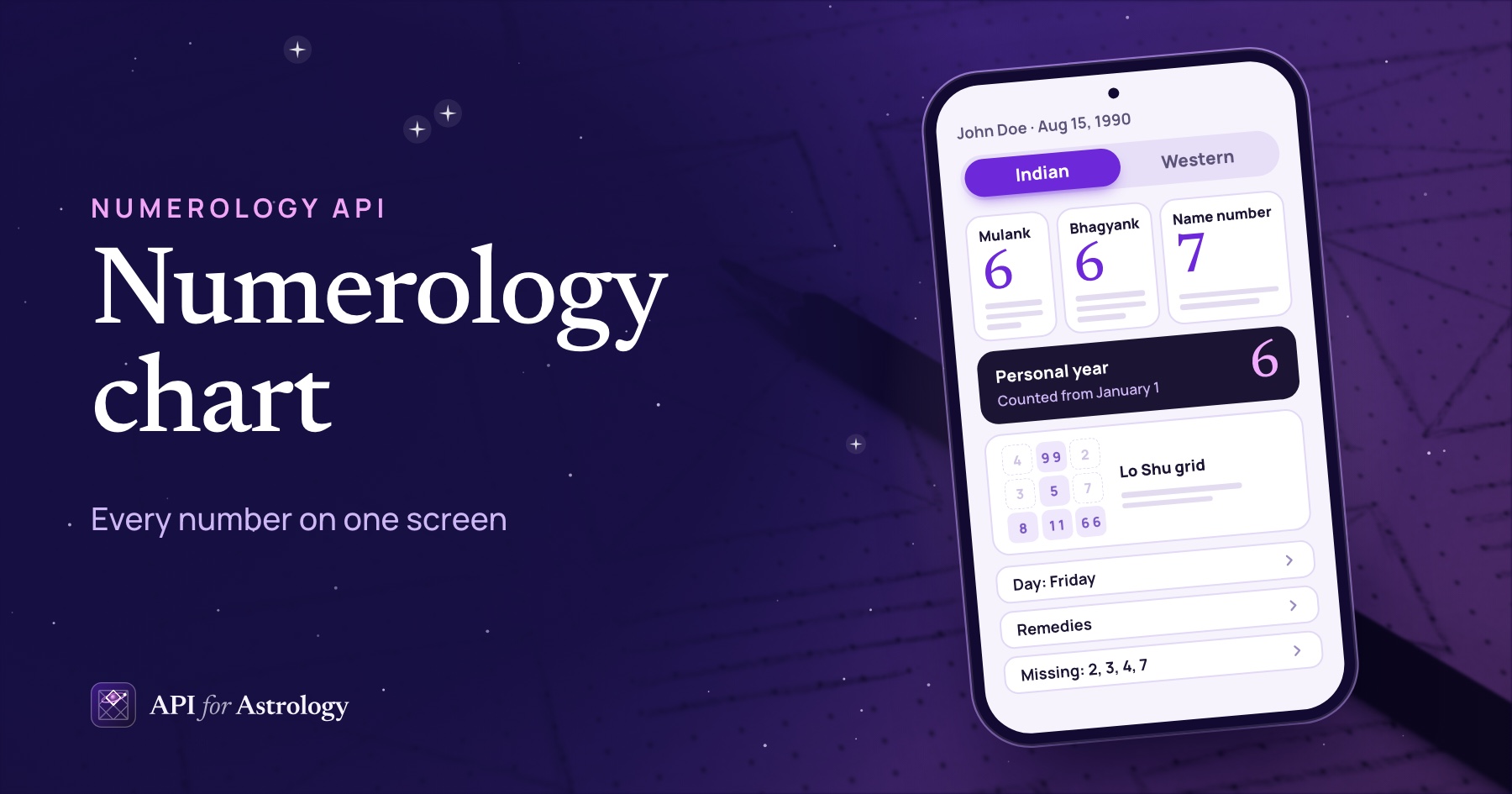
So on 39.82% of dates, one screen shows a master number and the other does not. Nov 29, 1984, is a Western-only date. John Doe, born Aug 15, 1990, is the reverse. The digits of his date total 33, which sets master to true on his bhagyank. Yet his life path is 6, his birthday 6, and his pinnacles 5, 7, 3 and 9.
A master value of true does not mean the total is 11, 22 or 33. Take a birth on Sep 1, 1990. Its digits add up to 29, then 11, then 2. The profile returns bhagyank 2 with total 29 and master true.
Of the 5,959 dates with the flag, 2,734 have a total of 29, 38 or 47, and each passes through 11. An app that prints total and number as a pair would show "29/2", which pairs no master number with its digit.
What to show on the Western screen
Keeping or reducing master numbers is one of the seven rules in our post on why numerology calculators disagree. Once your app keeps them, five display choices follow.
Choice | What to do | Why |
|---|---|---|
How to print it | Write "11/2": | A user who saw 2 in another app sees where it came from. |
Which reading | Show the | It is written for 11, 22 or 33, not for the digit. |
Your own 1 to 9 tables | Look up colors or icons by | A table for 1 to 9 has no row for 11. |
Sums in your code | Let the API add | Adding digits drops master numbers. |
Cycles, challenges, balance | Show no master badge | They never hold 11, 22 or 33 in this API. |
Numerology guides use the slash form too. Our free life path tool shows the pair another way. Under a master expression, soul urge or personality number, it prints a line such as "A master number (digit 2)".
The sums matter most for the pinnacles. For Nov 29, 1984, the API adds the kept parts: 11 + 11 = 22. Adding the digits instead, 2 + 2 gives 4. Done that way, the pinnacles come out 4, 6, 1 and 6, not 22, 33, 1 and 33. Over the 100 years, adding digits would drop a master pinnacle on 2.31% of dates. The maturity number also adds kept numbers, so it needs the same care.
Want to see a master number before you write any code? Try a date in the free life path number calculator. It calls POST /v1/western, so 11, 22 and 33 stay whole there too.

What to show on the Indian screen
On the Indian screen, the number is always the single digit. Print number as the bhagyank or the name number, and read it as that digit. For Sep 1, 1990, the API's bhagyank reading is written for 2.
Use master as a small note at most, such as "A master number came up in the sum." Never print 11 or 29 as the bhagyank. The mulank needs nothing extra, because it has no flag.
If one app shows both traditions, give each its own screen and label. The Indian vs Western numerology post lays out those two screens. The single digits match. The life path digit matched the bhagyank on every one of the 36,525 dates. For Sep 1, 1990, the Western screen prints 11/2 for the life path, and the Indian screen prints 2.
Every Western number, from the life path to the pinnacles, is listed on the Western numbers feature page. The API reference gives the type of every field.

Print number beside digit on the Western screen, and keep the Indian screen on the single digit. Those two rules cover all 36,525 dates we checked, including the 44.56% that carry a master number.