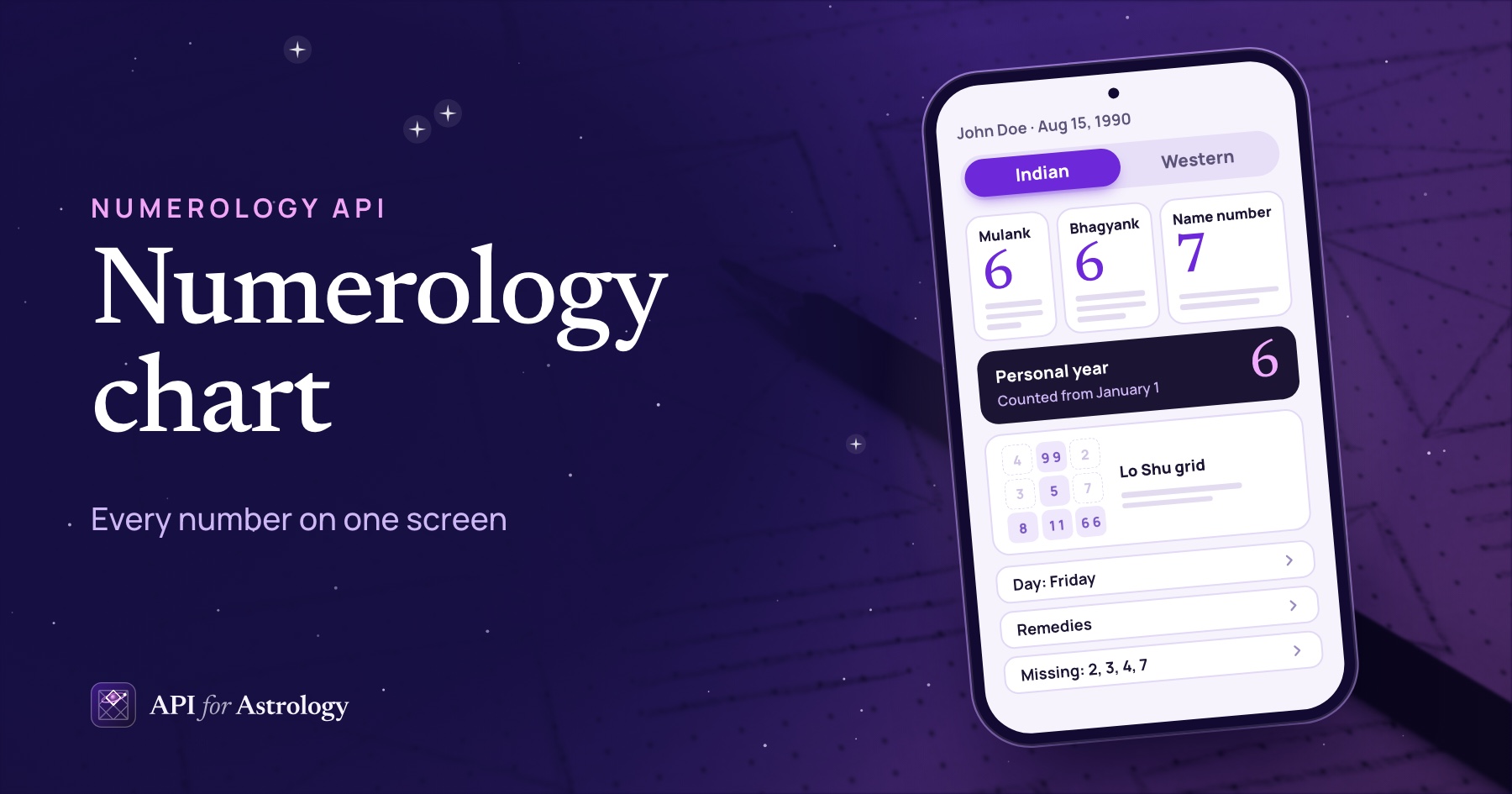

Indian and Western numerology take the same two inputs: a name and a birth date. Then they give back different numbers. Take John Doe, born Aug 15, 1990. Indian numerology, also called ank jyotish or Vedic numerology, gives him three core numbers. He has mulank 6 (from his birth day), bhagyank 6 (from his full birth date) and name number 7. Each one has a ruling planet. The Western set gives him a life path of 6, an expression of 8, a soul urge of 8 and a personality of 9. It has no planets.
The extras differ too. The Indian side adds a Lo Shu grid, a square of nine cells filled from the birth date. It also adds a lucky day, lucky colors, a gemstone and a mantra. The Western side adds life stages, challenge numbers, karmic numbers and a personal year.
So pick by audience. For an app in India, lead with the Indian numbers. For an app in the US, lead with the Western ones. For both markets, give each tradition its own screen and its own label. Never blend them into one card.
A blended card shows the clash at once. John's name number comes out as 7 in the Indian count and 8 in the Western one. Put both on one card with no label, and a user sees two answers to one question.

John Doe's numbers in Indian numerology
Our API returns the Indian numbers from POST /v1/profile. We ran it for John Doe on October 17, 2026. Here is what came back, with the sums behind each number.
Number | How it is added up | John Doe | Planet |
|---|---|---|---|
Mulank (birth day number) | Day 15: 1 + 5 | 6 | Venus |
Bhagyank (full birth date number) | 1 + 5 + 0 + 8 + 1 + 9 + 9 + 0 = 33, then 3 + 3 | 6 | Venus |
Name number, Chaldean letter values | John 18 + Doe 16 = 34, then 3 + 4 | 7 | Ketu |
In ank jyotish, each number from 1 to 9 belongs to a planet. Sun takes 1, Moon 2, Jupiter 3, Rahu 4, Mercury 5, Venus 6, Ketu 7, Saturn 8 and Mars 9. Rahu and Ketu are not bodies in the sky. They are the two places where the Moon's orbit crosses the Sun's yearly path, and Indian astrology counts them as planets.
The mulank's planet drives the rest of the answer. John's is Venus, so his lucky day is Friday. His lucky colors are white and pastel pink, and his friendly numbers are 4, 5, 6 and 8. Our mulank 6 page covers that number in full.
The Lo Shu grid holds every digit of his birth date except zero. The API also adds his bhagyank. It adds his mulank too, because his birth day has two digits. That leaves 2, 3, 4 and 7 empty, with 1, 6 and 9 twice each.
Last come the remedies, all from Venus. They are a direction (south-east), a deity (Lakshmi) and a fast day (Friday). Then come a gemstone (diamond) and a beej mantra (a seed mantra of a few sounds, said 108 times a round). The gemstone carries its own caution. In the API's words: "Numbers alone cannot say whether you should wear it, so check your birth chart with an astrologer first."
The same person in Western numerology
The Western numbers come from POST /v1/western. They use Pythagorean letter values, while the Indian name number uses Chaldean ones. The letter tables themselves are in Chaldean vs Pythagorean numerology, side by side, and on the letter charts page in the docs. Here the question is which numbers each side returns.
Number | John Doe | The working |
|---|---|---|
6 | Birth date: month 8, day 15 to 6, year 1990 to 1. Then 8 + 6 + 1 = 15, then 6 | |
Expression | 8 | All letters: John 20 to 2, Doe 15 to 6. Then 2 + 6 |
Soul urge | 8 | Vowels only: John 6, Doe 11. Then 6 + 11 = 17, then 8 |
Personality | 9 | Consonants only: John 14 to 5, Doe 4. Then 5 + 4 |
Maturity | 5 | Life path 6 + expression 8 = 14, then 5 |
Birthday | 6 | Birth day 15, then 1 + 5 |
The answer also carries numbers that the Indian answer does not have. Karmic debt numbers are 13, 14, 16 and 19, found when a sum passes through one of them. John meets 14 in his personality and maturity sums. His karmic lessons, the numbers no letter of his name gives, are 2, 3, 7 and 9. His four challenge numbers are 2, 5, 3 and 7.
The four pinnacles are long life stages, each with its own number. John's are 5 from birth to age 30, 7 from 31 to 39, 3 from 40 to 48, and 9 after that. The answer marks the second one as current. As of October 24, 2026, his personal year is 6, his personal month is 7 and his personal day is 4.
The Western answer has no planets, no lucky colors and no remedies.
Two calls, one request body
Both routes take the same body: the name, written in English letters, and the birth date. This is the Western call for John Doe.
John Doe, born Aug 15, 1990. Numerology needs no birth time or place.
curl -X POST "https://apiforastrology.com/api/numerology/v1/western?as_of=2026-10-24" \
  -H "Authorization: Bearer $ASTROLOGY_API_KEY" \
  -H "Content-Type: application/json" \
  -d '{"name":"John Doe","birth_date":"1990-08-15"}'
The Indian numbers come from the same body sent to /v1/profile. Here are both answers from our runs, trimmed to the fields that tell the two traditions apart.
John Doe, born Aug 15, 1990: POST /v1/profile, trimmed
{
  "mulank": { "number": 6, "planet": "Venus" },
  "bhagyank": { "number": 6, "total": 33, "planet": "Venus" },
  "name_number": {
    "default_system": "chaldean",
    "chaldean": { "total": 34, "number": 7, "planet": "Ketu" },
    "pythagorean": { "total": 35, "number": 8, "read": false }
  }
}
John Doe, born Aug 15, 1990: POST /v1/western, trimmed
{
  "system": "pythagorean",
  "life_path": { "total": 15, "number": 6, "digit": 6 },
  "expression": { "number": 8, "words": [20, 15] },
  "soul_urge": { "number": 8, "words": [6, 11] },
  "personality": { "number": 9, "karmic_debt": [{ "number": 14 }] },
  "personal": { "as_of": "2026-10-24", "year": { "number": 6 } }
}
Three fields keep the traditions apart. The Indian answer names its letter system in default_system. It also sends the Pythagorean name number, but only for comparison, marked "read": false. The Western answer says "system": "pythagorean" at the top. Your screens can take their labels straight from these fields.
Where the two traditions differ
Part of the answer | Indian ( | Western ( |
|---|---|---|
Letter values | Chaldean, 1 to 8 | Pythagorean, 1 to 9 |
Numbers from the date | Mulank, bhagyank | Life path, birthday |
Numbers from the name | One name number | Expression, soul urge, personality |
Planets | One for each number | None |
Grid | Lo Shu grid | None |
Everyday extras | Lucky day, colors, numbers and dates | Personal year, month and day |
Long view | None | Pinnacles and challenges, by age |
Remedies | Gemstone, mantra, direction, deity, fast day | None |
Master numbers 11, 22, 33 | Flagged, then read as one digit | Kept in |
Languages | English, Hindi and more as they launch | English, Hindi and more as they launch |
Reading credits a call | 3 | 3 |
Both routes take lang=hi for Hindi. On the Indian answer, John's planet comes back as शुक्र and his lucky day as शुक्रवार. The English codes stay in fields such as planet, so your code does not change.
What each audience searches for
Search data shows real demand on both sides. Keyword Planner gives worldwide numbers, so it cannot split them by country. The words themselves still tell you who is asking.
Search term | Monthly searches, worldwide | Route that answers it |
|---|---|---|
life path number | 100K to 1M | Western |
mulank | 10K to 100K | Indian |
indian numerology | 1K to 10K, up 900% in 3 months | Indian |
vedic numerology | 1K to 10K | Indian |
bhagyank | 1K to 10K | Indian |
numerology in hindi | 1K to 10K | Indian |
expression number | 1K to 10K | Western |
soul urge number | 1K to 10K | Western |
Mulank and bhagyank are Hindi words. People also type "mulank kaise nikale", Hindi for "how do I find my mulank", 1K to 10K times a month. That search asks for a mulank. Only the Indian answer returns one, with its planet and lucky day. With lang=hi, the planet and the day come back in Hindi. The search "life path number" asks for a number that only the Western answer returns.
The Indian answer's remedies come from its planets. The Western answer has no planets, so it has nothing to hang a gemstone or a mantra on. Keep the remedies on the Indian screen only.
How to show both without mixing them
Give each tradition its own screen or tab, named "Indian numerology" and "Western numerology". Fill each screen from one call only. Then each screen follows one set of rules.
Label every name number with its letter system. John's name gives 7 with Chaldean values and 8 with Pythagorean ones. Print "Chaldean" or "Pythagorean" beside it, taken from default_system or system. The Pythagorean number inside the Indian answer is marked "read": false. Show it on a small compare line at most, never as a reading.
Use each tradition's own words. Write mulank and bhagyank on the Indian screen, and life path and expression on the Western one. Do not rename one as the other, even when the values match. John's bhagyank and life path are both 6, but one comes from 33 and the other from 15.
Let the user choose. Set the default by the app's language or market, and let anyone switch in settings. A user in New York may follow ank jyotish, and a user in Mumbai may want a life path.
Both answers also carry a plain line saying that numbers show tendencies, not set events. Put that line beside the readings on each screen.
See every Indian field. The core numbers page lists what POST /v1/profile returns and the rules behind each number.

Which numbers to show, by audience
Your audience | Lead with | Call | Add | Leave out |
|---|---|---|---|---|
Users in India | Mulank, bhagyank, name number |
| Lo Shu grid, lucky colors and days, remedies with their cautions | Western numbers, or keep them on a second tab |
Users in the US | Life path, expression, soul urge, personality |
| Personal year, pinnacles as a timeline | Planets and remedies |
Both markets | The tradition the user picked | Both, one for each screen | A switch in settings | Any card that blends the two |
For a mixed audience, call only the route that the open screen needs. Each call uses 3 reading credits, so a user who opens both screens uses 6. A matching screen also sits on one side. POST /v1/compatibility reads the mulank and bhagyank, so it goes with the Indian set. Our numerology apps page shows how the other screens fit on the API.
Plan the Western screen. The Western numbers page shows what POST /v1/western returns, field by field. To try a date first, the free life path number calculator runs on that same route.
The short version
Indian and Western numerology read the same name and date in different ways. The Indian side reads three numbers through their planets, then adds a grid of the date's digits, lucky days and colors, and remedies. The Western side reads six numbers from the date and the letters, then adds life stages and yearly cycles. Lead with the side your users already know. When you serve both, give each one its own screen and its own label, and John's 7 and 8 never meet on one card.