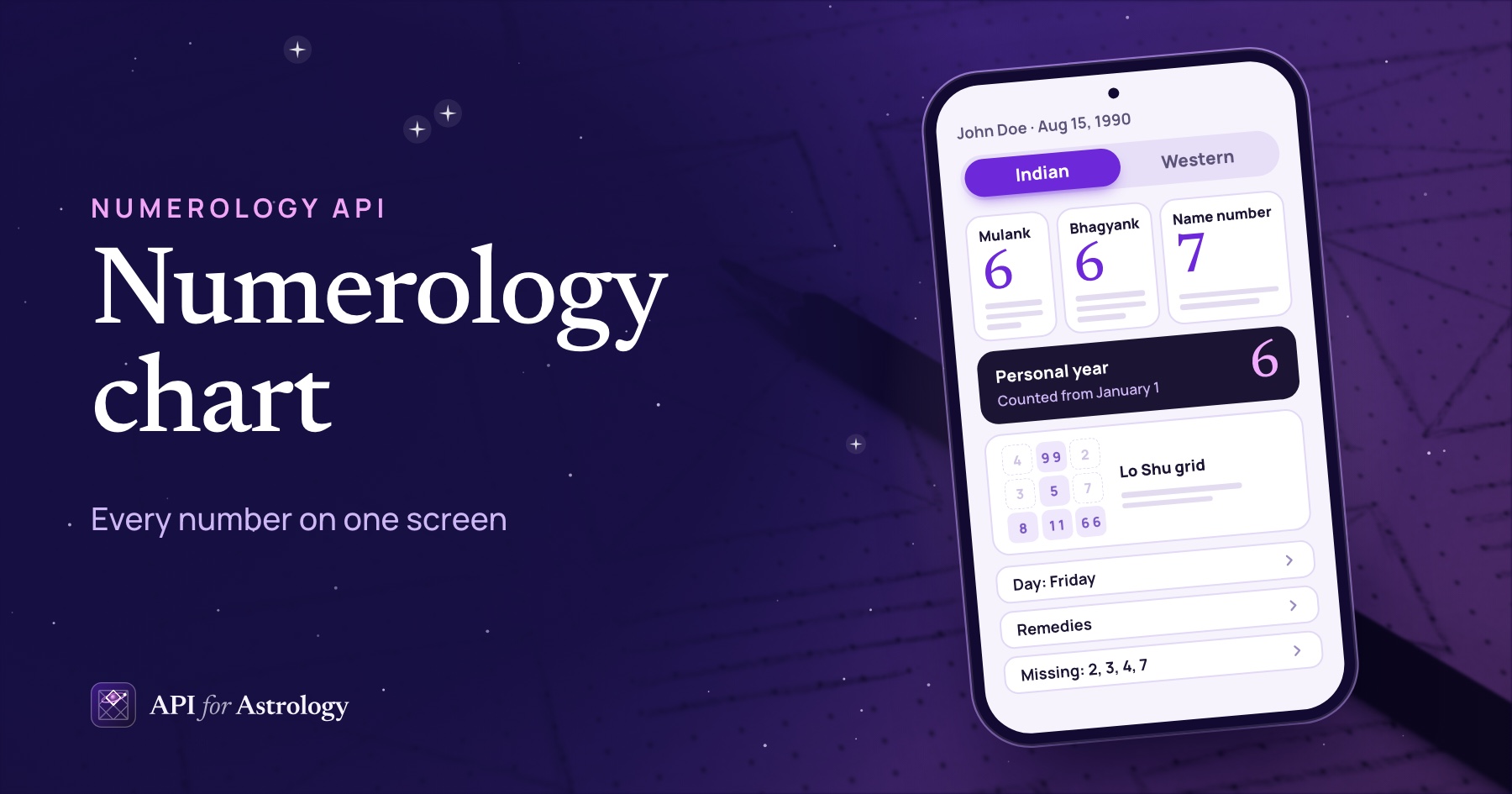
Chaldean and Pythagorean numerology turn the same letters into different numbers. Of the 26 letters, 16 change value from one table to the other. So one name can land on two numbers: John Doe comes out as 7 in Chaldean and 8 in Pythagorean.
The letter table is what sets them apart. Chaldean uses only the values 1 to 8, so no letter gets 9. Pythagorean counts 1 to 9 along the alphabet, then goes back to 1 at J. Both then add the values and reduce the total, which means adding its digits until one digit is left.
So which one should your app use? Let the number on the screen pick the table. The Indian name number, shown beside the mulank (birth day number) and bhagyank (destiny number), uses Chaldean. Every Western name number, such as the expression number, uses Pythagorean. Never run one table for both, and tag every number with the name of its system.
That is how our Numerology API works. POST /v1/profile reads the Chaldean name number and returns the Pythagorean count beside it, unread. POST /v1/western uses Pythagorean only. Below are both tables, real answers for three sample people, and two traps to avoid when you wire them up.
Chaldean and Pythagorean letter tables compared
Each row shows the letters that share one value.
Value | Chaldean letters | Pythagorean letters |
|---|---|---|
1 | A, I, J, Q, Y | A, J, S |
2 | B, K, R | B, K, T |
3 | C, G, L, S | C, L, U |
4 | D, M, T | D, M, V |
5 | E, H, N, X | E, N, W |
6 | U, V, W | F, O, X |
7 | O, Z | G, P, Y |
8 | F, P | H, Q, Z |
9 | none | I, R |
The Pythagorean table is the alphabet split into groups of nine. A is 1 and I is 9. Then J goes back to 1. Your code can work out any letter from its place in the alphabet.
The Chaldean table does not follow alphabet order, so your code needs the full lookup. It is uneven too: five letters share 1, and 7 and 8 get two each. Our API checks both tables when it starts. Each must hold all 26 letters exactly once, and no Chaldean letter may be 9.
Only 10 letters keep their value in both tables: A, B, C, D, E, J, K, L, M and N. The other 16 change. I moves the most. It is 1 in Chaldean and 9 in Pythagorean.
One name in both systems: John Doe
We sent John Doe, born Aug 15, 1990, to both routes of our API in October 2026. Here is each letter as the API counts it.
Letter | J | O | H | N | D | O | E | Total |
|---|---|---|---|---|---|---|---|---|
Chaldean | 1 | 7 | 5 | 5 | 4 | 7 | 5 | 34 |
Pythagorean | 1 | 6 | 8 | 5 | 4 | 6 | 5 | 35 |
In Chaldean, 34 reduces to 3 + 4 = 7. In Pythagorean, 35 reduces to 3 + 5 = 8. Only two letters made the gap. Going from Chaldean to Pythagorean, each O lost a point and the H gained three. That net point turned 34 into 35.

Jane Doe, born Mar 22, 1992, shows how little it takes. In her name, only the O changes value. That single point turns a Chaldean 28, which reduces to 1, into a Pythagorean 27, which reduces to 9.
How often the two systems agree
To test more than two names, we counted every first name in our API's baby-name list, 13,859 names, in both tables. We used the same counting code the API runs. Then we sent 11 names to the API itself, and all 11 answers matched our count.
The two systems gave the same single number for 1,527 names, or 11.0%. For the other 89.0%, the number changed. One in nine is 11.1%, so the two tables agree about as often as two random picks from 1 to 9 would. For 9 names in 10, switching systems gives a new number.
Chaldean still ends on 9. No Chaldean letter is worth 9, but a total can still reduce to 9. John alone adds up to 18 in Chaldean, and 1 + 8 = 9. Across the list, 11.0% of names end on 9 in Chaldean, close to the share of every other number. So keep 9 in your Chaldean screens and copy.
Compound numbers: the step before one digit
A compound number is the full total a name adds up to before you reduce it, such as John's 34. Chaldean books give a meaning to each total between 10 and 52. The API folds a larger total down into that range and returns null below 10.
The API returns John's 34 in compound and his 7 in number. It has no compound readings yet, as not_included.compound_meanings states, so every reading comes from the 7. The Western route has no compound field at all. Each number there is a single digit, unless it is 11, 22 or 33. Those stay whole as master numbers. So treat a compound number as a fact to display, not as a good or bad sign.
Why the API reads one system and returns the other
Indian numerology works in Chaldean, so the profile reads the Chaldean name number. But most Western books and apps use Pythagorean. A user who got 8 there may think your 7 is wrong. So the profile returns the Pythagorean count beside it, labelled, with numbers only.
Here is part of the name_number block for John Doe, born Aug 15, 1990, from POST /v1/profile:
{
  "default_system": "chaldean",
  "chaldean": {
    "system": "chaldean",
    "total": 34,
    "compound": 34,
    "number": 7,
    "master": false,
    "system_name": "Chaldean",
    "planet": "Ketu",
    "reading": "Your name gives a quiet, thoughtful feel. People may see you as private or deep."
  },
  "pythagorean": {
    "system": "pythagorean",
    "total": 35,
    "compound": 35,
    "number": 8,
    "master": false,
    "system_name": "Pythagorean",
    "read": false
  }
}
Three fields keep the systems apart. default_system says which block is read. Each block names its own table in system, with a label for your screen in system_name. And read: false marks the Pythagorean block as numbers only, with no planet and no reading.
What this means on screen. Show the Chaldean 7 with its planet and reading. Put the Pythagorean 8 in a smaller line, with its label. Do not build an empty reading card for it.
Which Western numbers use the Pythagorean table
POST /v1/western answers with "system": "pythagorean" and a basis block that states each method. But not every Western number reads the letters. Some come from the birth date alone, so the letter system cannot change them.
Western number | Built from | John Doe |
|---|---|---|
Expression | every letter of the name | 8 |
Soul urge | the vowels | 8 |
Personality | the consonants | 9 |
Maturity | life path + expression | 5 |
Karmic lessons | values no letter gives | 2, 3, 7, 9 |
Hidden passion | the most common value | 5 and 6 |
Balance | the first letter of each word | 5 |
Life path and birthday | the birth date only | 6 and 6 |
Challenges, pinnacles and personal year, month and day | the birth date (and today) | 4, 4 and 3 numbers |
The first seven use the Pythagorean table, and the rest never touch a letter. On the Indian side, too, only the name number depends on Chaldean.
Try any name in our free name numerology calculator. It shows the Chaldean and Pythagorean numbers side by side, so you can see the gap before you build anything.

Two traps when you wire both systems
Trap 1: the profile's Pythagorean count is not the expression number. Both use the same table, but they add in a different order. The profile adds every letter, then reduces the total. The Western route reduces each word first, then adds the words and keeps master numbers.
For John Doe, both give 8. For Lisa Doe, they do not. Lisa adds up to 14 and Doe to 15. The profile adds them to 29 and reduces that to 2, with master: true because 11 came up on the way. The Western route reduces 14 to 5 and 15 to 6, then adds them: 11. So her expression number is 11, with 2 in digit. Read the expression number from POST /v1/western only.
Trap 2: the two routes ask for different names. The profile wants the full name in daily use. The Western route asks for the full name from birth. These differ for anyone who changed their name, such as after marriage. If you show both systems, ask for both names, or say which name each number used.
Both routes take names in English letters only. Names in other scripts, such as Hindi, get an error, since a new spelling means a new number.
Which system should your app use?
Pick by the numbers your users expect, then label everything.
Your screen shows | Letter table | Route |
|---|---|---|
Mulank, bhagyank and name number | Chaldean, read |
|
Expression, soul urge, life path and the rest | Pythagorean |
|
A name number that users compare with other apps | Both, labelled |
|
If your users know Indian numerology, lead with the Chaldean number and its reading. Show the Pythagorean number small, with its label. The name checker compares spellings in both systems.
If they learned from Western books, use the Western route and skip the Chaldean block. The Western numbers page lists everything it returns. If you serve both groups, give each system its own tab or card, named on screen.
Both letter charts, with one name worked through each, are on the Chaldean and Pythagorean charts page in the docs. For every rule the API follows, from master numbers to how a Y is counted, see the numerology conventions. Field types are in the API reference.

Get both answers from the API
Send the same body to both routes. Here it is for John Doe, born Aug 15, 1990:
{
  "name": "John Doe",
  "birth_date": "1990-08-15"
}
And here is the top of the POST /v1/western answer, with most numbers left out:
{
  "system": "pythagorean",
  "basis": {
    "letters": "Pythagorean letter values (A=1 ... I=9, J=1 ...).",
    "name_numbers": "Each word is reduced, then the words are added."
  },
  "expression": {
    "total": 8,
    "number": 8,
    "digit": 8,
    "karmic_debt": [],
    "words": [20, 15]
  }
}
words lists each word's sum before reducing: 20 for John and 15 for Doe. Both routes take lang (en or hi) and detail (standard or expanded). Both answers also say, in not_claimed, that numbers describe tendencies, not fixed events.
The letter table is one small lookup in your code. Yet it moved John Doe from 7 to 8, and it changed the number for 89% of the names we counted. Choose it from the numbers you show, and print its name beside each one.