
Lucky dates by numerology start with one step: give each date a number of its own. Add every digit of the day, the month and the year. Keep adding until only one digit is left. In the Indian system our API uses, that digit belongs to a planet. The API then asks how two of the person's planets see it. One rules the mulank, worked out from the birth day alone. The other rules the bhagyank, which adds up the whole birth date. A date is a Good fit when one of the two counts its planet as a friend, and neither counts it as an enemy.
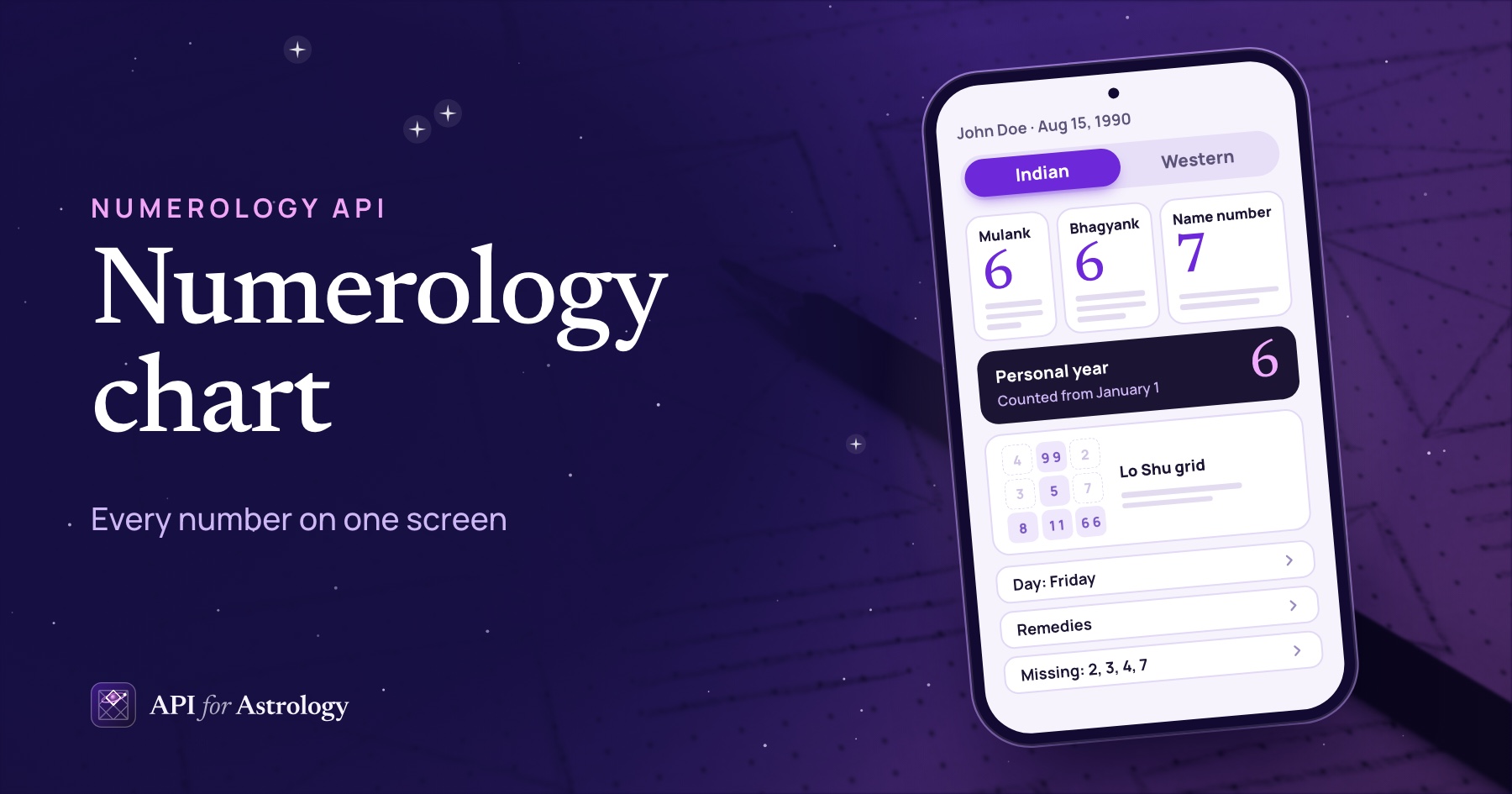
Meet John Doe, born Aug 15, 1990. Both of his core numbers, mulank and bhagyank, come to 6, the number of Venus. We sent his birth date to POST /v1/dates for December 2026. One call returned all 31 dates, each with a label: 15 Good fit, 10 Neutral and 6 Not a good fit. A good list in the answer named the 15 good dates.
A calendar screen needs only a few rules on top. Show each date with the API's own label. Make one call per person per month. For an event two people share, keep only the dates on both good lists. And never call a date "guaranteed" or "a lucky day to sign a deal".
Every number here is real. The calendars are API answers from October 2026. The counts come from the code behind the API, run over 47,847 birth dates and 60 months.
How numerology picks good dates: one number for each date
Start with Dec 1, 2026. Its digits are 1, 1, 2, 2, 0, 2 and 6. They add up to 14, and 1 + 4 makes 5, the number of Mercury in Indian numerology. Venus, John's planet, sees Mercury as a friend. That makes Dec 1 a Good fit for him.
Now Dec 6. Its digits make 19, then 10, then 1. That is the Sun's number, and Venus treats the Sun as an enemy. That puts Dec 6 under Not a good fit.
The month and year stay put, so the numbers climb in order. Each new day adds 1 to the date's number, and after 9 the count goes back to 1. So every number lands on 3 or 4 dates in a month. Here is John's whole December, grouped by number:
Date number | Planet | How Venus counts it | Label | December 2026 dates |
|---|---|---|---|---|
1 | Sun | enemy | Not a good fit | 6, 15, 24 |
2 | Moon | enemy | Not a good fit | 7, 16, 25 |
3 | Jupiter | neutral | Neutral | 8, 17, 26 |
4 | Rahu (as Saturn) | friend | Good fit | 9, 18, 27 |
5 | Mercury | friend | Good fit | 1, 10, 19, 28 |
6 | Venus | the same planet | Good fit | 2, 11, 20, 29 |
7 | Ketu (as Mars) | neutral | Neutral | 3, 12, 21, 30 |
8 | Saturn | friend | Good fit | 4, 13, 22, 31 |
9 | Mars | neutral | Neutral | 5, 14, 23 |

Two numbers borrow a planet. Rahu and Ketu, the planets of 4 and 7, are left out of the old friendship table. So the API uses Saturn in place of Rahu, and Mars in place of Ketu.
John's calendar has no Mixed date. A Mixed label needs a friend on one side and an enemy on the other. John's mulank and bhagyank are the same number, so the two checks always give the same answer. That is true for 11.0% of birth dates: the ones whose mulank equals their bhagyank.
The answer states its own rule. Here is its rule line, in the API's words:
"A good date is one whose number gets along well with your own numbers and does not clash with either."
The test is the one the API runs on a phone number. The mobile number numerology post takes that test apart, link by link.
Each date also carries a personal day number from 1 to 9, a theme only, which plays no part in the label.
Jane's December: when two numbers pull apart
Jane Doe was born Mar 22, 1992. Her mulank is 4 (2 + 2), the number of Rahu. For her bhagyank, the digits total 28, then 10, then 1, the Sun's number. Saturn, standing in for Rahu, and the Sun see each other as enemies.
So most dates please one of her planets and not the other. Her December held 7 Good fit dates and 24 Mixed. Only the numbers 3 and 5 pass on both sides. Her good dates are Dec 1, 8, 10, 17, 19, 26 and 28.
Jane sits at the low end. Just four pairs of mulank and bhagyank have only two good date numbers. They are 1 with 4, 1 with 8, 4 with 1, and 8 with 1. Together they cover 5.3% of birth dates. Jane gets 6 to 8 good dates a month.
Mixed is a label of its own. It means one of her numbers welcomes the date and the other does not. Do not fold it into Good fit or into Not a good fit. Show it with its own name and its own look.
How many good dates a month usually has
We counted with the code behind the route. We ran it for every birth date from Jan 1, 1900, to Dec 31, 2030. That is 47,847 people, each read for 60 months, from January 2026 to December 2030. One person's calendar for one month is a person-month below. Our script's labels matched all 10 API answers we fetched, date for date.
What we counted | Result |
|---|---|
Average good dates a month | 14.6 |
Median | 15 |
Fewest in one month | 6 |
Most in one month | 22 |
Person-months with 13 to 16 good dates | 49.4% |
Person-months with 17 or more | 30.3% |
Person-months with 8 to 12 | 15.8% |
Person-months with 6 or 7 | 4.5% |
Months with no good date | 0 |
About half of all dates come back good. Across 87,368,622 person-dates, 47.9% were Good fit and 22.8% were Mixed. Another 15.3% got Not a good fit, and 14.0% got Neutral. So a "good days" calendar marks roughly every other square.
No month is ever empty. Every person has at least 2 good date numbers, and at most 6. Each number lands on 3 or more dates a month. So everyone gets at least 6 good dates. The answer does have a none field, with a line for a month that has no good date. In 2,870,820 person-months, it never came back. Keep a spot for it on screen anyway.
John's count moves between 12 and 15. His four good numbers give him 13.6 good dates a month on average. December 2026 is one of his fuller months.
Lucky dates by numerology: why other guides pick other days
The profile has a fixed list. POST /v1/profile returns lucky.dates: the days of any month whose own digits add up to a friendly number of the mulank. For John, that is 13 days, the same in every month. Our post on lucky numbers, colors and days explains where that list comes from.
A real month moves most of that list. In December 2026, only 4 of John's 13 favorable dates are Good fit: the 4th, 13th, 22nd and 31st. Three are labelled Not a good fit: the 6th, 15th and 24th. Those are John's own birth day numbers. In December 2026, each of those dates adds up to 1, the Sun's number.
Across everyone, fewer than half of the fixed days hold. Over all 60 months and all 47,847 birth dates, 47.2% of the fixed days were Good fit in the real calendar. Another 16.2% were marked Not a good fit. So show the fixed list as a fact about the person. Use POST /v1/dates for anything with a real date on it.
Other guides use other rules again. We read five outside pages for this post. One numerologist calls a day lucky when its own digits add up to the birth day's digit. By that rule, John's lucky days are the 6th, 15th and 24th of every month. Another numerology API returns the list 6, 15 and 24 for someone born on the 24th, with no month attached. One wedding guide uses each partner's Western personal day. It favors 2, 3, 6, 8, 11 and 22, and steers couples away from 4 and 5.
Our API reads the whole date against two Indian numbers. A rule that reads only the day of the month repeats the same dates every month, so its days differ from ours. Put one line under your calendar that names the rule you show.
The day route answers a different question
The day route takes a date and no person. We sent Dec 4, 2026, to GET /v1/day. Its digits add up to 17, then 8, ruled by Saturn. The answer gives that number and a theme for the day. Then it adds one row for each of the nine mulanks, saying how that mulank's planet counts Saturn.
For mulank 4, the day route says Good fit. Rahu, read as Saturn, meets Saturn itself, so the row counts it as a friend. Jane's own calendar marks Dec 4 as Mixed. Her bhagyank's planet, the Sun, counts Saturn as an enemy. The day route reads one of Jane's numbers, and the dates route reads two.
The two routes often disagree. For Jane, they give different labels on 27 of December's 31 dates. They match only on the 1st, 10th, 19th and 28th. Across every person and month we counted, they disagree on 39.5% of dates. For people like John, whose mulank equals their bhagyank, they never disagree. For everyone else, the share is 44.4%.
Give each route its own screen. The day route suits a page with no birth date, such as "today's number" with a line for each mulank. A person's calendar should come from POST /v1/dates. Never fill a personal calendar from the day route's rows.
Two people, one event: dates good for both
Two people, two calls. A wedding involves two people, and so can a business with two partners. Call POST /v1/dates once for each person, for the same month. Then keep the dates that appear in both good lists.
John and Jane share 4 dates in December 2026. They fall on Tuesday, Dec 1; Thursday, Dec 10; Saturday, Dec 19; and Monday, Dec 28. Each adds up to 5, ruled by Mercury, the only number good for both. In each month of 2026, the two share 3 or 4 dates.
About 1 couple in 6 never shares a good date. We paired every birth date in our range with every other one. For 16.6% of those pairs, the two people's good numbers have nothing in common. That leaves no date good for both, in any month. On average, a pair shares 7.2 dates a month. A pair with even one good number in common shares at least 3 dates.
Plan that empty screen first. Say plainly that no date this month suits both people's numbers. Then show each person's label for each date, side by side, and let the couple choose. Do not merge the two labels into a score of your own. The API has none, and a made-up score could not be traced to a rule.
The labels do not depend on the event. The dates route takes no event type, so a wedding and a move get the same labels. For a time of day, the Astrology API's muhurat search finds windows, as our post on how muhurat is calculated explains.
The request and the answer
Here is the call for John's December. It needs a birth date and a month, and nothing else.
John Doe, born Aug 15, 1990, for December 2026.
curl -X POST "https://apiforastrology.com/api/numerology/v1/dates?month=2026-12" \
  -H "Authorization: Bearer $ASTROLOGY_API_KEY" \
  -H "Content-Type: application/json" \
  -d '{"birth_date":"1990-08-15"}'
John Doe's December 2026 answer, trimmed to the first three dates.
{
  "person": { "birth_date": "1990-08-15", "mulank": 6, "bhagyank": 6 },
  "year": 2026,
  "month": 12,
  "month_name": "December",
  "days": [
    { "date": "2026-12-01", "day": 1, "weekday": 2, "number": 5, "planet": "Mercury", "planet_name": "Mercury", "outcome": "good", "outcome_name": "Good fit", "personal_day": 1 },
    { "date": "2026-12-02", "day": 2, "weekday": 3, "number": 6, "planet": "Venus", "planet_name": "Venus", "outcome": "good", "outcome_name": "Good fit", "personal_day": 2 },
    { "date": "2026-12-03", "day": 3, "weekday": 4, "number": 7, "planet": "Ketu", "planet_name": "Ketu", "outcome": "neutral", "outcome_name": "Neutral", "personal_day": 3 }
  ],
  "good": [1, 2, 4, 9, 10, 11, 13, 18, 19, 20, 22, 27, 28, 29, 31],
  "none": null
}
The full days list has all 31 dates. The answer also holds about, rule, not_claimed and localization.
See every date route in one place. The personal year and dates API page sets the dates route and the day route beside the cycles and mulank year routes. Each comes with what it returns.

Always send the month. Without month, the API reads the month from its own clock. When we left it out on Oct 19, 2026, October came back. On the last night of a month, that may not be the month on the user's screen.
Bad input gets a 422 with a reason. For month=2026-13, the code was invalid_input and the field was query.month. A request missing its birth date, and one with Feb 30, 1990, both named birth_date.
Weekdays run from 1 to 7. In weekday, 1 is Monday and 7 is Sunday. Dec 1, 2026, comes back as 2, a Tuesday. A grid that starts on Sunday needs one small step, shown below.
Key on the code, show the name. Use outcome in your logic and outcome_name on screen. The code stays good, neutral, mixed or difficult in every language. With lang=hi, the names arrive in Hindi: अच्छा मेल, सामान्य, मिला-जुला and मेल नहीं खाता. December becomes दिसंबर. Asking for detail=expanded changed no text in this answer.
These two JavaScript functions build the month grid and the couple's list. We ran both on all 10 dates answers we fetched, English and Hindi alike. All 13 checks passed.
// A month calendar from one POST /v1/dates answer.
// Each row is one week, Sunday first. Each cell keeps the API's own label.
export function monthGrid(answer) {
  const weeks = [];
  let week = [null, null, null, null, null, null, null];
  for (const date of answer.days) {
    // weekday is 1 (Monday) to 7 (Sunday), so 7 % 7 puts Sunday in column 0.
    const column = date.weekday % 7;
    week[column] = { day: date.day, label: date.outcome_name, isGood: date.outcome === "good" };
    if (column === 6) {
      weeks.push(week);
      week = [null, null, null, null, null, null, null];
    }
  }
  if (week.some((cell) => cell !== null)) weeks.push(week);
  return weeks;
}

// The dates good for both people: two POST /v1/dates answers for the same month.
export function goodForBoth(first, second) {
  const secondGood = new Set(second.good);
  return first.good.filter((day) => secondGood.has(day));
}
For John's December, the first row comes out as two empty cells, then Dec 1 to Dec 5. For John and Jane, goodForBoth returns 1, 10, 19 and 28.
Each call uses 1 reading credit. One person's month is 1 credit, and a couple's month is 2. A year view is 12 credits per person, one call for each month the user opens. GET /v1/day also uses 1 credit per date. Only the docs' sample people get answers on a test key, with no month or with month=2026-10.
Build decisions for the calendar screen
Print the API's labels, not your own. Good fit, Neutral, Mixed and Not a good fit are all a user needs. Do not rename Not a good fit with a darker word, and do not paint it red.
Use calm, plain words. "A good fit for your numbers" is enough. Never write "guaranteed", "lucky day to sign a deal" or "best day of the month". The good dates are not ranked, and every Good fit date stands equal.
Name the rule under the calendar. Show the about line. It says each date is read against the mulank and bhagyank, in the way a phone number is. Add the user's two numbers from the person block, such as "Your numbers: 6 and 6." A user who compares apps then knows why the days differ.
Learn the number behind each date. The universal day entry in our glossary shows how a date adds up to its number, with a worked example. To find a user's mulank and bhagyank first, try the free numerology calculator.

End on the closing line. Each answer closes with not_claimed. It tells users the numbers show leanings only, as a guide for planning and not a rule. Show it below the calendar, in the user's language.
Ask for the month the user is looking at. Send that month each time the user opens the calendar or moves to the next month. Work out the month from the user's own date, not your server's.
Keep the couple view honest. List the shared dates first. If there are none, say so, then show both rows of labels. Never move a Mixed date into the shared list.
The short version
Numerology gives each date one number from all its digits. Our API weighs that number against the person's two numbers, mulank and bhagyank, through the friendships of their planets. POST /v1/dates labels every date of a month in one call, for 1 credit. The average is 14.6 good dates a month, and nobody gets none. For a couple, keep the dates both answers call good, and plan for the 1 pair in 6 that shares none.