


To offer numerology in Hindi, an app needs one setting and one form rule. The setting is lang=hi. Add it to a call, and the reading text arrives in plain, everyday Hindi. Planet names, weekdays, colors and topic titles switch with it. Every number, code and key stays the same. For John Doe, born Aug 15, 1990, all 101 numbers, flags and empty values matched.
The form rule is about names. Our API only counts names written in English letters. A name typed in Devanagari (the script used to write Hindi) gets a 422 error. The letter tables only cover A to Z, and one Hindi name can have several English spellings. We sent सौरभ शर्मा as Saurabh, Sourabh, Saurav and Sourav Sharma. They gave four name numbers: 9, 6, 8 and 5.
So a Hindi app asks users to spell the name in English letters, with a short Hindi hint. It keeps the user's Devanagari name for display only. Its cards say मूलांक (mulank, the birth day number), भाग्यांक (bhagyank, the destiny number) and नामांक (the name number). Each screen ends with the API's disclaimer line in Hindi. A Hindi reading uses the same credits as an English one.
Below are the real answers behind each point, from runs on Oct 19, 2026.
Numerology in Hindi: what lang=hi changes
We sent John Doe's POST /v1/profile call in both languages: first lang=en, then lang=hi. The two answers had the same shape: 251 values, each in the same place. This is what happened to them.
John Doe (Aug 15, 1990), both languages side by side, from POST /v1/profile.
Kind of value | Count | With lang=hi |
|---|---|---|
Numbers, true or false flags, and empty values | 101 | All the same |
Readings, topic texts and | 83 | All in Hindi |
Codes and keys, such as | 55 | All the same |
The name and birth date you sent | 8 | The same, as typed |
The beej mantra, in two scripts | 2 | The same in both |
The two notes in | 2 | All in Hindi |
No number moves. The mulank is 6 in both answers. The bhagyank is also 6, after its digits sum to 33. The name adds up to 34, which gives 7. The friendly numbers, the Lo Shu grid and every count stay the same too.
Each code gets a Hindi twin. The code keeps its English value. A second field beside it carries the word to show.
Code field | Code | Display field | Hindi word |
|---|---|---|---|
| Venus |
| शुक्र |
| Friday |
| शुक्रवार |
| pastel pink |
| हल्का गुलाबी |
| south-east |
| दक्षिण-पूर्व |
| chaldean |
| कैल्डियन |
| nature |
| स्वभाव (नेचर) |
Write every rule against the code column. Print the display column. Then one screen serves both languages, and a user can switch without your logic changing. Our numerology API quickstart shows this first call in English.
Some topic titles keep an English word in brackets. The nature title comes back as स्वभाव (नेचर), and the health title as सेहत (हेल्थ) की आदतें. The bracket holds the English word, written in Hindi letters. Print the title as it comes. Cutting the bracket to save space changes the API's text.
What still comes back in English
Two things in a Hindi answer are not in Hindi. Plan for each one.
The name, as sent. The answer repeats the name in input.name, in each letter table's block and in each word's total. All of them stay in English letters, exactly as typed. The profile never writes the name in Devanagari. If a card should show सौरभ शर्मा, that text has to come from the user.
Error messages. The message of a 422 error is in English, with lang=hi and with lang=en. The next section shows it.
One more block looks English but is not a gap. The beej mantra, a short chant tied to the planet, comes in Devanagari in mantra.text and in English letters in mantra.latin. Both languages send both. Show text on a Hindi screen and latin on an English one.
The profile also carries two short notes in not_included, and both came back in Hindi. One says the compound number, the name's two-digit total, has no reading yet. The other says the Western numbers come from another route. They speak to your team, not to users, so keep them off the screen.
Nothing fell back to English in our runs. The list in localization.fell_back_to_en would name each text that came in English for lack of a Hindi version. It was empty for John's profile, and for the guide route below.
The script problem: a name in Devanagari gets a 422
Here is the profile call with the name typed in Hindi. The birth date is John Doe's, Aug 15, 1990.
The name सौरभ शर्मा (Saurabh Sharma), born Aug 15, 1990.
curl -X POST "https://apiforastrology.com/api/numerology/v1/profile?lang=hi" \
  -H "Authorization: Bearer $ASTROLOGY_API_KEY" \
  -H "Content-Type: application/json" \
  -d '{"name":"सौरभ शर्मा","birth_date":"1990-08-15"}'
The API sends back status 422, its code for a request it cannot use.
{
  "error": {
    "code": "invalid_input",
    "message": "Write the name in English letters (A to Z). Other scripts are not read, because the spelling changes the number.",
    "field": "name"
  }
}
A mixed name got the same answer. We sent Saurabh शर्मा. Its first name used English letters, while the family name was in Hindi. The API refused it, with the same field and the same message.
Why the API refuses. Our API holds two letter tables, Chaldean and Pythagorean. Each gives a value to the 26 English letters, A to Z, and to nothing else. When the service starts, it checks that each table holds all 26 letters, each one once. A Devanagari letter has no value in either table. To count it, the API would first have to write the name in English letters. That step has no single answer, as the next section shows. So the API asks for the spelling, and never guesses one the person may not use.
The rule is wider than Hindi. A name must start with an English letter. After that, it may hold more English letters, plus apostrophes, hyphens, dots and spaces. Digits, accented letters and every other script get the same 422.
A refused call costs nothing. The API sets the reading credits aside before a call. When the call fails, it gives them back. So only the call that goes through, after the name is fixed, uses credits.
A test key gets the same 422. Test keys answer only for the docs' John Doe and Jane Doe. But a name the API cannot read goes on to the API, so a test key sees this same 422. Other names in English letters get a 403 (sample_charts_only).
One Hindi name, four spellings, four name numbers
सौरभ शर्मा is one name with one sound. In English letters, it can be written in several ways. We sent four spellings that keep that sound, each with the same birth date, Aug 15, 1990.
Four English spellings of सौरभ शर्मा, all with the birth date Aug 15, 1990, sent to the profile route with lang=hi.
Spelling | First name | Sharma | Total | Name number | Planet |
|---|---|---|---|---|---|
Saurabh Sharma | 20 | 16 | 36 | 9 | Mars (मंगल) |
Sourabh Sharma | 26 | 16 | 42 | 6 | Venus (शुक्र) |
Saurav Sharma | 19 | 16 | 35 | 8 | Saturn (शनि) |
Sourav Sharma | 25 | 16 | 41 | 5 | Mercury (बुध) |
The mulank and the bhagyank were 6 and 6 in all four answers. They come from the date, so the spelling cannot touch them. Only the name number moved, and it landed on four different planets.

Two letter choices made the gap. In the Chaldean table, used in Indian numerology, A is worth 1 and O is worth 7. So "Sau" and "Sou" differ by 6. B is 2 and H is 5, so "bh" is worth 7, while "v" is worth 6. Those two choices alone spread one name over four numbers.
The Western count moved as well. The Pythagorean table, common in Western books, gave 4, 9, 7 and 3 for the same four spellings. A different table gives a different spread, but the problem is the same.
This is why the right input is the spelling the person already uses. Changing a spelling on purpose, to reach a number, is a separate job called name correction. Our name correction numerology post covers it. A Hindi app's name field has a simpler task: take the person's own spelling, and read that one.
Build the name field for Hindi users
Ask for the spelling the user writes every day. The profile reads the name as it is written and used now, not the name from a birth record. So the hint should ask for the everyday spelling.
Put a short Hindi hint under the field. Here is a set of form texts in plain spoken Hindi.
Part of the form | Text in Hindi | What it says |
|---|---|---|
Field label | नाम (अंग्रेज़ी अक्षरों में) | Name (in English letters) |
Hint under it | वही स्पेलिंग लिखें जो आप रोज़ इस्तेमाल करते हैं, जैसे Saurabh Sharma। | Type the spelling you use every day, such as Saurabh Sharma. |
Second field, not required | हिंदी में नाम (अगर चाहें) | Name in Hindi (if you like) |
Message for Devanagari in the first field | नाम अंग्रेज़ी अक्षरों (A से Z) में लिखें। हर स्पेलिंग से नंबर बदल सकता है। | Write the name in English letters (A to Z). Each spelling can change the number. |
Check the field before you call. The API's rule fits in one line of JavaScript. This function tells your form whether to send the name, or which Hindi message to show.
// The API's rule for names: start with an English letter, then use only
// English letters, spaces, dots, hyphens and apostrophes.
const ENGLISH_NAME = /^[A-Za-z][A-Za-z .'-]*$/;
// Devanagari, the script Hindi is written in, is the Unicode block U+0900 to U+097F.
const DEVANAGARI = /[\u0900-\u097F]/;

// Returns null when the name can be sent, or the Hindi message to show.
function nameProblem(typed) {
  const name = typed.trim().split(/\s+/).join(" ");
  if (ENGLISH_NAME.test(name)) {
    return null;
  }
  if (DEVANAGARI.test(name)) {
    return "नाम अंग्रेज़ी अक्षरों (A से Z) में लिखें। हर स्पेलिंग से नंबर बदल सकता है।";
  }
  return "नाम में सिर्फ़ A से Z के अक्षर लिखें।";
}
We ran it on the 8 names from our runs. It passed John Doe and the four Sharma spellings, which the API read. It stopped जॉन डो, सौरभ शर्मा and Saurabh शर्मा, which the API refused. The API also caps a name at 100 characters, so set the same limit on the field.
Key on the field, not the message. If a 422 still comes back, check that error.code is invalid_input and error.field is name. Then show your Hindi message beside the name box. The API's own message stays in English.
Never turn Devanagari into English letters for the user. A converter has to choose one spelling, such as Saurabh or Sourabh. Each choice is a different number, and the user never saw it. Ask the user to type it instead.
Keep the Devanagari name for display. If the user fills in the second field, print it on the card, above the spelling that was read. Never send it to the API. Here is the name card for Saurabh.
Card line | Shows | Comes from |
|---|---|---|
Name | सौरभ शर्मा | the second field, as the user typed it |
Spelling read | Saurabh Sharma |
|
Label | नामांक | the word in |
Number and planet | 9, मंगल |
|
The "spelling read" line shows the user which spelling made the 9. If they write Sourabh, they can fix it and see their own number.
Hindi labels, digits and the working
Take the labels from the API's own words. The Hindi about lines call the three core numbers मूलांक, भाग्यांक and नामांक. Use the same three words as card titles, so each title matches the text under it. Our numerology chart post lists the Hindi labels for the rest of a chart.
Write buttons in the same voice as the readings. The API's Hindi uses नंबर for "number", the English word in Hindi letters. A button such as नंबर देखें ("see the numbers") matches it.
Match your digits to the reading text. John's Hindi profile has 23 digits inside its texts. All 23 are Western digits, 0 to 9. None is a Devanagari digit, ० to ९. So print your number tiles in Western digits too. If your design needs Devanagari digits, change every digit on the screen, readings included. A card should never show 6 on the tile and ६ in the text.
Show dates day first. The API takes and returns the birth date as 1990-08-15. On a Hindi screen, write it with the day first and the Hindi month name: 15 अगस्त 1990.
Show the working once, in Hindi. "Mulank kaise nikale" asks, in Hindi, how the mulank is worked out. It gets 1K to 10K searches a month worldwide. A Hindi card can answer it with the user's own numbers. Here is the working for Saurabh Sharma, born Aug 15, 1990.
Number | The working, in Hindi | In English |
|---|---|---|
मूलांक | जन्म की तारीख़ 15 है। 1 + 5 = 6। | The birth day is the 15th. 1 + 5 = 6. |
भाग्यांक | पूरी तारीख़ के अंक जोड़ें: 1 + 5 + 0 + 8 + 1 + 9 + 9 + 0 = 33। फिर 3 + 3 = 6। | Add every digit of the date: 33. Then 3 + 3 = 6. |
नामांक | Saurabh 20 और Sharma 16, कुल 36। फिर 3 + 6 = 9। | Saurabh 20 plus Sharma 16 makes 36. Then 3 + 6 = 9. |
Each part of the working is in the answer or in your request. The 15 is the day you sent. The 33 is bhagyank.total. The 20 and 16 are the word totals in name_number.chaldean.words. Our post on the three core numbers walks through each step in English. The glossary defines each one: mulank, bhagyank and name number.
End each screen with the Hindi disclaimer. With lang=hi, the not_claimed line arrives in Hindi. For John, the API's answer read: "नंबर झुकाव बताते हैं, तय घटनाएँ नहीं। इन्हें राह दिखाने वाला मानें, नियम नहीं।" In plain words, the numbers show tendencies and leave the outcome open. Print it as sent, at the foot of every screen with a reading.
A Hindi mulank page with GET /v1/guide/{number}
Some screens have no birth date. A content page about मूलांक 6 is one, and a preview before sign-up is another. GET /v1/guide/{number} reads a single mulank (1 through 9) with no date at all.
The guide for mulank 6, in Hindi. No person or date is needed.
curl "https://apiforastrology.com/api/numerology/v1/guide/6?lang=hi" \
  -H "Authorization: Bearer $ASTROLOGY_API_KEY"
What came back, cut down to the fields a page header uses
{
  "number": 6,
  "planet": "Venus",
  "planet_name": "शुक्र",
  "born_on": [6, 15, 24],
  "lucky": {
    "day": "Friday",
    "day_name": "शुक्रवार",
    "colors": [
      { "color": "white", "name": "सफ़ेद" },
      { "color": "pastel pink", "name": "हल्का गुलाबी" }
    ],
    "numbers": { "friendly": [4, 5, 6, 8], "neutral": [3, 7, 9], "unfriendly": [1, 2] }
  },
  "localization": { "lang": "hi", "detail": "standard", "fell_back_to_en": [], "fell_back_to_standard": [] }
}
`born_on` lists the days that give this mulank. For 6, they are days 6, 15 and 24 in every month. Open the page with those dates, in your own Hindi words, so readers can check that the page is theirs.
The guide follows the same rule as the profile. Its answer held 112 values. All 33 numbers and flags matched the English answer. 48 texts came back in Hindi. The other 31 were codes and the mantra in its two scripts. No English text was left, and neither fallback list named anything.
The readings match the profile's. The guide's short mulank and bhagyank readings were word for word the same as John's, whose numbers are both 6. So a user who reads the page and then enters a birth date sees one voice. The site's mulank 6 page reads the same number in English.
Want to see every field of the profile and the guide before you build the Hindi cards? Our mulank and bhagyank API page lists what each one returns, with a sample answer.

Calls and credits in Hindi
Here is the full profile call for John Doe in Hindi. It is the docs' sample request, with lang=hi added.
The full Hindi call for John Doe (Aug 15, 1990).
curl -X POST "https://apiforastrology.com/api/numerology/v1/profile?lang=hi" \
  -H "Authorization: Bearer $ASTROLOGY_API_KEY" \
  -H "Content-Type: application/json" \
  -d '{"name":"John Doe","birth_date":"1990-08-15"}'
What came back, cut down to the three core numbers, the lucky day and the language block
{
  "mulank": { "number": 6, "planet": "Venus", "planet_name": "शुक्र" },
  "bhagyank": { "number": 6, "total": 33, "master": true, "planet": "Venus", "planet_name": "शुक्र" },
  "name_number": {
    "default_system": "chaldean",
    "chaldean": {
      "name": "John Doe",
      "total": 34,
      "number": 7,
      "system_name": "कैल्डियन",
      "planet": "Ketu",
      "planet_name": "केतु"
    }
  },
  "lucky": { "day": "Friday", "day_name": "शुक्रवार" },
  "localization": { "lang": "hi", "detail": "standard", "fell_back_to_en": [], "fell_back_to_standard": [] }
}
Leave out lang=hi, or send lang=en, for English. The numerology conventions page explains the language and length settings.
Hindi costs the same. Every numerology answer is paid for in reading credits, and the language never changes the count.
Call | Reading credits in English | Reading credits in Hindi |
|---|---|---|
| 3 | 3 |
| 3 | 3 |
A name refused with a 422 | 0 | 0 |
One answer carries one language. A family screen that shows Hindi beside English needs two calls. For one person's profile, that is 6 credits in all. A user who switches language later also needs a new call.
Try the numbers first. Our free numerology calculator runs the same profile route. Type Saurabh Sharma and then Sourabh Sharma with the same date to watch the name number change.
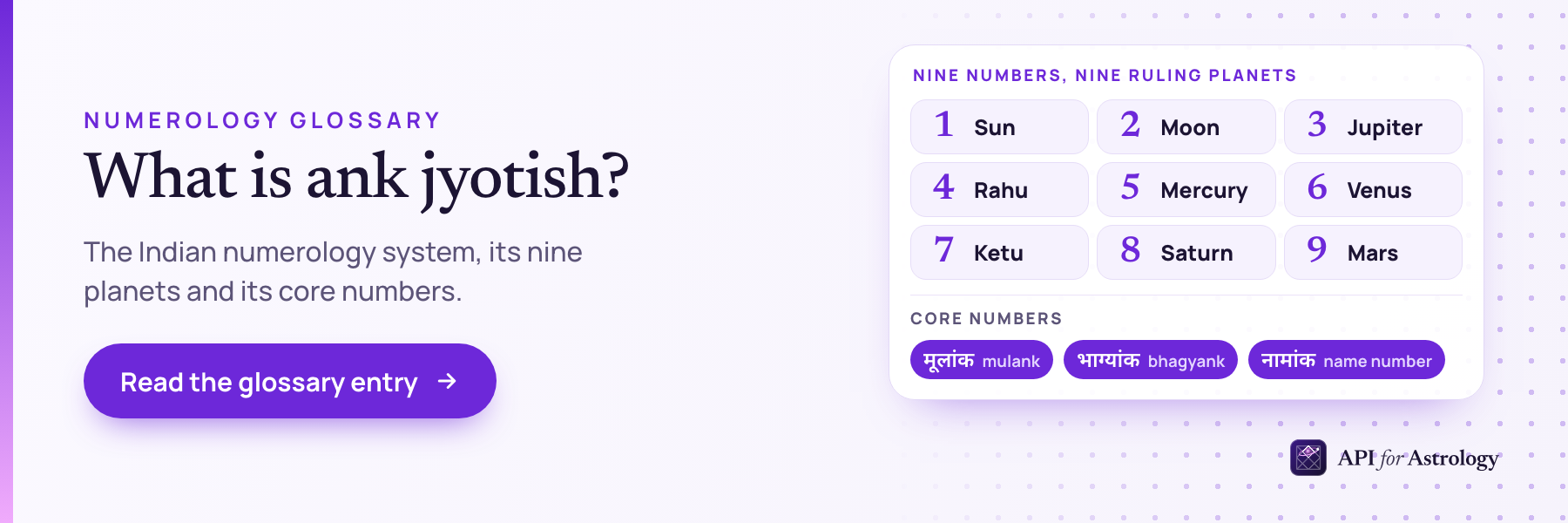
The Indian system behind these numbers has a name of its own: ank jyotish. Our glossary entry on ank jyotish explains its nine ruling planets and how the API follows them.
The short version
lang=hi changes the words and never the numbers. In John's profile, every reading and note turned Hindi, while every number, flag and empty value stayed put. Two things stay in English: the name as sent, and the error message. Write your own Hindi for the error.
The name field needs the most care. The API counts only English letters, since the spelling sets the number. सौरभ शर्मा, spelled four ways, gave 9, 6, 8 and 5, all with the same date. A converter would pick one of those four for the user without asking. A field with a Hindi hint lets the user pick, and the card shows सौरभ शर्मा above the spelling that made the number.


